
Alpha Bank CEO Vassilios Psaltis ranked #1 CEO in Greece and in EMEA for the third consecutive year – New distinctions for Alpha Bank
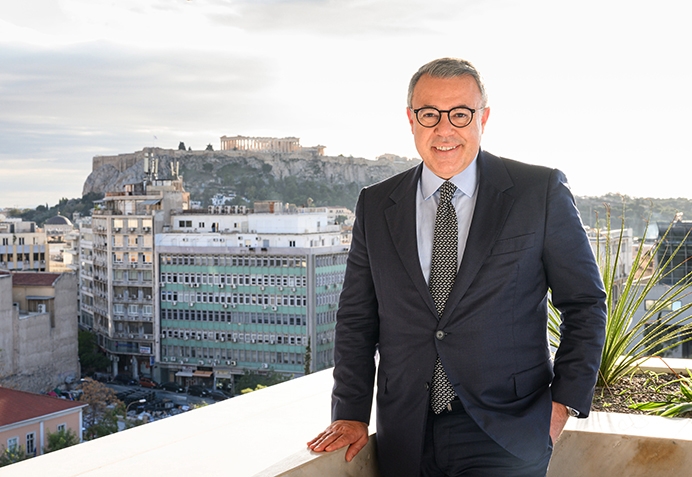
For the third consecutive year, Alpha Bank CEO Vassilios Psaltis has been named top CEO in Greece and across the broader EMEA region, according to the annual Emerging EMEA Executive Team survey conducted by Extel. The survey collects the views of 546 executives, analysts and portfolio managers from 341 companies, evaluating candidates active in emerging economies in Europe, the Middle East and Africa. At the same time, Alpha Bank was recognized for the third consecutive year as the leading banking institution in Greece, securing distinctions across 7 categories and achieving the highest weighted score among the banking institutions in the Emerging EMEA region.
Vassilios Psaltis named top CEO
For the third year running, Alpha Bank CEO was recognized as the best CEO across all sectors in Greece, as well as in the EMEA region within the financial services sector. This distinction reflects the international investment community’s confidence in the strategy that the Bank has been pursuing over the past years, culminating in the strongest financial results reported in its history, in 2025. Notably, Vassilios Psaltis has been recognized repeatedly through the Extel survey, evidence of the enduring confidence that investors express in his role, first as CFO and since 2019 as the CEO, in relation to the Bank’s strategic trajectory.
“Earning top distinctions from a respected organization, particularly when they stem from the assessment of investors and analysts active in the international market, makes us proud. They reflect the relationships of trust we have forged over time with the investment community, as well as their recognition of the quality of our strategic choices and the consistency of our execution, in creating value for our shareholders,” Vassilios Psaltis said.
A triple first for the IR team
Confirming the consistency and quality of its communication with the investment community, Alpha Bank’s Investor Relations team retained the top position in three categories:
– IR Program
– IR Team
– Investor/Analyst Event
In addition, the Bank’s Investor Relations Director, Iason Kepaptsoglou, was named top IR Professional for the third consecutive year, in recognition of his effectiveness in communicating with the investment community.
A leap for ESG, top place for the Board of Directors
The progress achieved by the ESG team is also noteworthy: having ranked 3rd last year, it claimed 1st place this year in the ESG Program category. At the same time, the Bank’s Board of Directors was recognized as the best in the Company Board category.
First time eligible in the survey, CFO Vasilis Kosmas ranks in top 3 position
At the same time, Vasilis Kosmas, who participates in the survey for the first time since taking over the role of Chief Financial Officer at the Bank, ranked among the top 3 preferences of investors and analysts. This distinction is recognition of both the strategic allocation of capital and the transparency of his communication with the market.
Vassilios Psaltis: “Proud of relaunching Galaxy” – The challenges that Banks will be facing in the post-pandemic era
Highlights from the intervention of Alpha Bank’s CEO Vassilios Psaltis at the 22nd Capital Link Invest in Greece Forum
The imminent successful completion of Project Galaxy, amidst the unprecedented challenges of the global pandemic crisis, has once again confirmed the trust of the international investment community in Alpha Bank, as well as the Bank’s operational readiness and its commitment to achieving its strategic goals, said Mr. Vassilios Psaltis, Alpha Bank’s CEO, among other things, during his intervention at today’s 22nd Capital Link Invest in Greece Forum.
“We are proud of relaunching Project Galaxy – the second largest rated NPL securitization in Europe – immediately after the first lockdown and driving the transaction throughout the second lockdown”, said Mr. Psaltis, adding that this reflects positively not only on the Bank’s operational readiness and the attraction of Cepal, but also “on the significant uplift that Greece as a brand has experienced, given the handling of the pandemic and the propensity to reforms that the Government is demonstrating”.
Mr. Psaltis pointed out that Alpha Bank has already built up credibility with US investors, starting with the setting up of Cepal – the first servicing company licenced by the Bank of Greece – with Centerbridge, then selling large business loan portfolios to Apollo and Fortress, and, now, being in discussions with Davidson Kempner to sign Galaxy, which will include taking up Cepal, one of the largest servicers in Southeastern Europe. “Clearly, these investors have taken a positive view on the recovery of the Greek real estate market”, said Mr. Psaltis.
Alpha Bank’s CEO stressed that it is a “key priority” for Greek banks to de-risk their balance-sheets by addressing legacy NPE portfolios, adding that they have made substantial progress since 2016, reducing NPEs by almost 60% and reaching Euro 68 billion by year-end 2019. He spoke about an “impressive” overall amount of NPE securitizations under way in the Greek banking market over the past two years (Euro 33 billion) and highlighted that the newly-established Greek servicing market was a vital precondition in the clean-up of the balance sheets that underpinned the sale of domestic NPEs in the secondary market.
Discussing the challenges of Covid-19 and the efforts of Greek banks to bring down their NPEs to the levels of their European peers, Mr. Psaltis highlighted the role of the loans in moratoria, which make approximately 15% of Greek banks’ performing loans.
Alpha Bank’s CEO talked about the decisive action that has already been undertaken to limit the consequences of the lockdown, including the Greek government’s fiscal and liquidity stimulus of approximately Euro 30 billion to support the economy, the state subsidized instalments for retail borrowers under the so-called “Gefyra” program and the state sponsored loan programs in order for businesses to replenish their working capital.
The Greek government’s decisive action to address the consequences of the pandemic, Mr. Psaltis said, coupled with the operational readiness of Greek banks, which have been maintaining an active dialogue with their customers and are offering new products with adequate repayment schedules, creates the certainty that the risk of the Greek banking system facing a new generation of NPLs because of the moratoria is limited.
Regarding the Eurogroup’s recent decision, which essentially puts pressure on Greek banks to meet the 5% NPL threshold by 2022, Mr. Psaltis stressed that a series of initiatives, including the government’s intention to extend the Hercules program and the European Commission’s initiatives concerning the establishment of national Asset Management Companies (AMC) which coincides nicely with an initiative from the Bank of Greece to create an AMC, provide the necessary tools that would allow for a swift takeover of newly-created NPLs.
While exchanging views with the CEOs of the other three systemic banks regarding the prospects of development for the financial sector in the post-Covid era, Mr. Psaltis said that “despite the challenges, Greek banks need to fulfill their raison d’ être by supporting the real economy”.
The timely execution of the EU financing support programs, which exceeds Euro 70 billion for Greece, is of great importance for the recovery of Greek economy, said Mr. Psaltis. He added that “banks have an important role to play, as they can quickly mobilize their business customers and help them shape up their investment propositions in a way that it will ensure their eligibility under the RRF, but at the same time also comply with the banks’ credit standards. Therefore, the banks should be involved not only as a mechanism for the optimal distribution of the society’s savings, but also as advisors. This will allow them to mobilize funds for investments towards the digital and green transitions as well as inclusive growth, export orientation, innovation and the creation of scale economies in the Greek market. In other words, banks should be involved as engines of growth through a multitude of roles – financial market intermediaries, investors and employers.”