
OceanScore opens Japan office to strengthen regional support for EU ETS and FuelEU compliance

OceanScore has announced the opening of its Japan office, representing the next step in strengthening its presence in the Asia-Pacific region. The opening reflects OceanScore’s focus on providing proximity and structured support for Japanese shipowners and managers as the commercial implications of EU ETS and FuelEU Maritime grow. This has become increasingly important as EU ETS and FuelEU Maritime increase the complexity of global regulatory requirements and the related commercial exposure and risks.
The new office follows a year of increased engagement across APAC and with several Japanese companies. OceanScore already supports clients including Iino Kaiun Kaisha, Mitsui O.S.K. Lines, MMS and Meiji Shipping, with additional regional partnerships underway as EU environmental regulations gain momentum.
The Japan operation is led by Jyouichi Syou, Representative of Japan, who joined OceanScore in December 2025, supported by Leo Grayson, Head of Commercial – APAC, who has coordinated much of the regional engagement and preparation for this step.
OceanScore explains that EU ETS and FuelEU Maritime are straightforward from a regulatory perspective as the verifiers manage the technical side. The real challenge lies in the commercial processes that follow: determining exposure, allocating costs correctly between owners and charterers, issuing statements and invoices, preparing for FuelEU pooling and tracking EUAs and balances.
For organisations outside Europe, the challenge is not the regulation itself. It is the growing commercial workload that follows from operating under multiple systems — EU ETS, FuelEU Maritime, and soon UK ETS. As obligations expand, maintaining control over exposure, cost allocation, statements, pooling decisions, and the associated workflows becomes increasingly difficult without structured processes and regional support.
“EU ETS and FuelEU Maritime apply globally, regardless of a company’s trading pattern. The key is not understanding the regulation, but handling the commercial impact.” said Leo Grayson (pictured, right), Head of Commercial – APAC at OceanScore. “For Japanese shipowners and managers, local support and reliable systems help reduce compliance risk. Our Japan office enables closer cooperation, faster access to relevant information, and an ongoing exchange of practical experience and best practices.”
In recent months, OceanScore has seen rising demand in Japan for exposure forecasting, transparent cost allocation, structured workflows, and region-specific support for both EU ETS and FuelEU Maritime.
The Japan office complements OceanScore’s presence across Asia, with the Singapore office providing dedicated support through structured, data-based workflows for EU ETS and FuelEU Maritime. More than 900 vessels across the region already rely on Compliance Manager, OceanScore’s integrated platform for managing these regulations.
“With the expansion into Japan, we are reinforcing our commitment to the region,” said Jyouichi Syou (left), Representative of Japan. “Japanese shipping is global and systematic. Our task is to support this with transparent, reliable compliance processes that reduce risk and align with established operational standards.”
OceanScore’s 2026 strategy focuses on strengthening its APAC support structure, enhancing exposure forecasting, expanding service frameworks, and preparing clients for the next phases of EU regulation, including FuelEU pooling and potential extensions of emissions requirements for global voyages.
“Japan’s shipping community has always worked with a high degree of structure and long-term planning,” said Albrecht Grell, Managing Director of OceanScore. “Opening our office in Tokyo is a practical step to support clients locally. We recognise the challenges many Asian owners face in accessing and interpreting EU regulations, and we aim to provide the transparency and foresight needed to manage compliance with confidence.”
With the Japan office now operational, OceanScore continues to build a regional network capable of supporting one of the most important centres of global shipping. The objective remains clear: make compliance manageable, transparent, and commercially sound, wherever a vessel is traded from.
“As EU regulations expand, proximity matters,” Grell added. “In Japan, we see a consistent focus on efficient and transparent processes. Our role is to support that reliably and professionally.”
OceanScore – Represented by Oriani Hellas – Engages Greek Shipping Community in Key Discussions on FuelEU and Sustainability at Two Major Events in Athens
Last week, OceanScore reaffirmed its commitment to the Greek maritime industry by actively participating in two prominent events in Athens, to share latest insights into FuelEU, as well as conducting on-site workshops with clients to transfer practical knowledge and best practices. As the shipping industry prepares for the upcoming FuelEU Maritime regulations that come into effect 1 Jan 2025, OceanScore is leading the conversation on the regulatory landscape, preparations needed, and the commercial opportunities that lie ahead.
The first event, Marine Money Athens, took place on October 15. Ralf Garrn, OceanScore’s Co-Managing Director delivered an insightful presentation on the commercial and financial opportunities associated with FuelEU. His speech emphasized the need for shipowners and operators to act swiftly to comply with the new regulatory requirements, which aim to significantly reduce greenhouse gas emissions from maritime transport. FuelEU represents not only a challenge, but also a pathway to new revenue streams for proactive companies that are ready to embrace the technology leading to more informed decisions. Discussions about the commercial options and joint benefits must occur between all three main stakeholders (Owner, DOC Holder and Charterer) “No one can make a beneficial decision alone. It will be a joint effort to transform FuelEU penalties into a commercial benefit for all the parties involved.”, says co-Managing Director, Ralf Garrn.
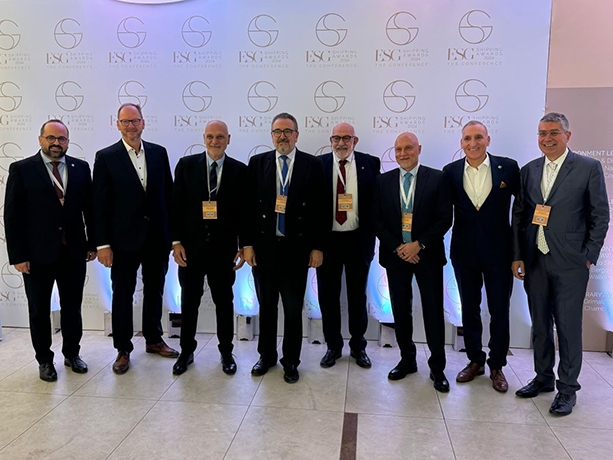
The week concluded with OceanScore’s participation in the ESG Shipping Awards Conference on October 18. Ralf Garrn moderated a high-level panel discussion on climate change, the evolution of environmental regulations, pathways to zero emissions, and sustainable solutions.
The panel featured key industry figures, including Sylvain Julien and Michael Blanding from Berge Bulk, Stergios Stergiou from Capital Group, Vasileios Kosmas from Carnival Corporation, Avraam Gelegenis from Diana Shipping Inc., and Dimitris Solomonides from Lemissoler Navigation Co Ltd, among others. The conversation underscored the urgent need for the maritime sector to adopt greener practices and highlighted practical approaches to achieving decarbonization goals.
OceanScore’s participation in these events, and its continued local presence and support provided through Oriani Hellas, reflects its ongoing dedication to the Greek market, a region that plays a pivotal role in global shipping. Frequent visits to Greece to meet with clients and prospects enable OceanScore to stay closely aligned with the local market’s needs and regulatory concerns. The company continues to support Greek shipowners and operators in navigating complex topics such as the European Emissions Trading System (ETS) and FuelEU regulations by offering tailored solutions designed to ensure compliance and operational efficiency.
“With the introduction of FuelEU Maritime next year, the shipping industry is facing one of the most transformative regulatory shifts in decades,” said Ralf Garrn. “We value our longstanding relationships with Greek shipowners and operators, and we are committed to helping them seize the opportunities that these changes bring while ensuring they meet sustainability targets.”
OceanScore’s FuelEU Planner provides a comprehensive tool set for simulating scenarios of different fuel types and offshore power, also factoring in bunker and ETS costs. By leveraging real-time data analytics and automated reporting, OceanScore empowers the maritime industry to enhance efficiency, reduce costs, and not only achieve compliance with ease, but to also find the opportunity in the regulations.