
#NotAlone: Deutsche Bank launches campaign to highlight the impact of COVID-19 on the mental health of young people
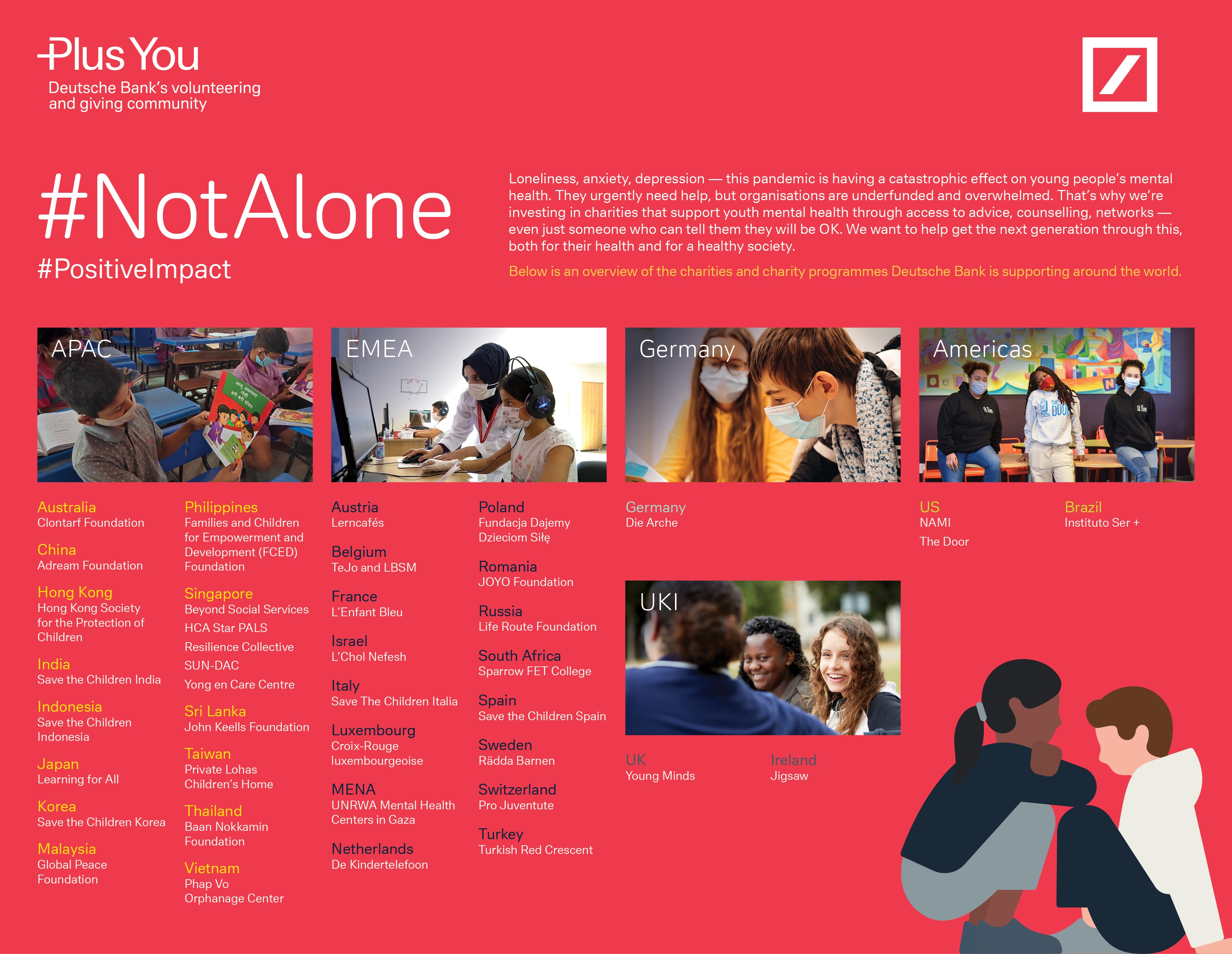
Loneliness, anxiety, depression — this pandemic has had a catastrophic effect not only on the physical, but also on the mental health of people across the world. Isolation has presented specific challenges for young people, broadly defined as those under the age of 18. Empowering the next generation to reach their full potential is one of the core commitments of Deutsche Bank’s corporate social responsibility strategy. That’s why we are launching #NotAlone, as part of our global Born to Be youth engagement programme, to help address this pressing issue. And our employees around the world can help invest more through our #NotAlone steps challenge.
Risking the potential of an entire generation
When schools and colleges close young people become disconnected, and not just from education. Many lose the structure and emotional support they rely on to keep going day to day. The pandemic has also heightened worries about the future, with education and career paths at risk. And lockdowns have increased the risk of abuse, neglect and self-harm, and make it even harder for those affected to be heard.
There has been a lot of media coverage across the world highlighting this issue, which will affect young lives for many years to come. At the end of last year, Deutsche Bank’s Corporate Social Responsibility (CSR) team conducted a horizon scanning research project on the mental health impact of COVID-19 on young people, to get a better understanding of the challenges and to identify areas that require support in response to the issues arising. The findings were alarming:
40% of 11- to 17-year-old children and adolescents in Germany say their mental health has been affected by the pandemic
1.5 million young people under 18 will need mental health support in the UK alone.
25% of young people in the US have had suicidal thoughts during lockdown.
In Asia, calls to domestic abuse helplines for young people have increased by 50%.
The economic cost of the skills gap from this disruption will run into billions of euros.
Our response
Young people urgently need help with all of this. They need access to advice, counselling, support networks — to someone who can tell them they will be OK. These resources have never been more in demand, yet they don’t always get the funding they deserve. And there is no quick fix, because the impacts of this pandemic will be felt for years to come. Deutsche Bank will offer relief by partnering with expert charities in this space and by providing financial support for strategic programmes.
The bank has identified youth mental health charities in more than 30 countries. In the UK, for example, we are partnering with Young Minds, the region’s leading charity supporting young people’s mental health. They have established a Coronavirus and mental health hub which gives advice and guidance to young people on how they can tackle anxiety, loneliness, bereavement, and much more. Our partner in the US, The Door, supports young people through individual and group services, care coordination and crisis intervention. Aligning with Deutsche Bank Americas Foundation’s student homelessness strategy, The Door serves an estimated 30% of youth experiencing housing insecurity, substance use and abuse, family disconnection and trauma. The German charity Die Arche provides regular telephone calls and video chats to overcome physical distance and to observe the child’s behaviour carefully to discover severe problems before they emerge. In the APAC region and Europe for example, we support the work of Save the Children Foundation in six countries. Globally, the foundation has provided nearly half a million children and adults with mental health and psychological support.
Every step helps us invest more for young mental health
Since lockdown has been hard on everyone we are launching regional #NotAlone steps challenges to help our employees look after their own health and wellbeing too. By taking part in these, our employees can earn extra funding for our charitable partners as specific targets are met. The global steps challenge will be built on last year’s success when around 8,100 employees achieved over 1.3 billion steps, and thereby raised € 220,000 for more than 20 charities.
“There are millions of young people who feel all alone right now. We would like to encourage all our employees to get behind our #NotAlone campaign to help support the next generation through this challenging time”, says Lareena Hilton, Global Head of Brand Communications and Corporate Social Responsibility at Deutsche Bank.
Source: Deutsche Bank
Cigna Foundation announces availability of $5 Million in grants to address children’s mental health, childhood hunger
The Cigna Foundation is inviting nonprofits working to create greater access to mental health services to apply for funding through its Healthier Kids For Our FutureSM grant program. The program will provide up to a total of $5 million in grants to community organizations over the next year.
Healthier Kids For Our FutureSM is a five-year, $25 million global initiative to improve the health and well-being of children that launched in 2019. Phase I focused on reducing childhood hunger and improving nutrition, awarding more than $4.5 million in grants to-date.
In Phase II, the program will add an additional focus area, addressing the mental health and well-being of children. Nonprofits working to improve childhood hunger can still apply as well.
Many families across the country are facing increased stress and anxiety right now. Prior to COVID-19, up to 20 percent of children and adolescents worldwide experienced mental illness1, and the pandemic is shedding light on a worsening mental health crisis – as both children and adults are struggling with anxiety, loneliness, and isolation.2 Cigna’s 2018 Loneliness Index also found that Generation Z (ages 18-22) are the loneliest generation and claim to be in the worst health.3
“With Cigna and the Cigna Foundation operating around the world, we see how a lack of quality nutrition in children can lead to long-lasting physical and mental health problems,” said Susan Stith, executive director, Cigna Foundation. “That’s why we’re looking to continue to partner with organizations that are already working to positively impact the health and well-being of children. Given what we’re seeing play out through Cigna’s landmark loneliness study, and the impact the coronavirus pandemic is having on childhood hunger and mental health, it’s more important than ever to connect the dots among communities and schools as we work together to reach more children in need.”
The Cigna Foundation is looking to partner with school systems and surrounding communities – including clinicians, local and national nonprofits – to supplement existing programming for children to help close gaps both within and outside the school environment.
Programming requirements should include:
Food insecurity, hunger or nutrition education programs.
Mental health programs with a focus on loneliness, anxiety, depression and suicide prevention.
Grants will be considered for school-based or non-school-based programming, and summertime programs. In some instances, multi-year requests will be considered.
To determine grant eligibility, start here.
Bank of Scotland new £20 notes worth £112,590 to Mental Health UK
• Special edition notes sold at auction to generous bidders• All money raised will support 14 – 18 year olds’ mental health resilience.
Bank of Scotland has raised £112,590 for Mental Health UK after auctioning off valuable versions of its upcoming £20 Polymer bank note.
A total of 92 notes that contain desired serial numbers were up for grabs at the auction run by SPINKS in London on the 12th February, with every single one being snapped up by attendees.
In addition, bidders could get their hands on 50 commemorative notes.These notes feature the Queensferry Crossing on the reverse, as well as the most sought after serial numbers with the AA pre-fix. Only these 50 notes will ever be printed with the AA pre-fix on the commemoratve design.
Thanks to the generous public for their bids, a fantastic £112,590 has been raised for Bank of Scotland’s charity of the year, Mental Health UK.
Brian Dow, Chief Executive of Mental Health UK, said: “At Mental Health UK we know there is a growing need for support for young people. That’s why, with funding from Bank of Scotland and the rest of Lloyds Banking Group, we created Bloom – the largest UK-wide programme for 14-18 year olds – which focuses on supporting young people’s mental health resilience. With this support we can expand the reach to over half a million young people, equipping them with the tools and knowledge needed to support their mental health now and in the future.”
Tara Foley, Managing Director, Bank of Scotland said: “Thank you to everyone who bought one of these very special £20 polymer bank notes. Not only do they now own a piece of history, they have also put money towards a cause which is very close to our hearts at Bank of Scotland.”
£20 Polymer Note Reflecting the new notes due into circulation later this month, the 50 special edition Queensferry Crossing notes are printed with a unique serial number, commencing with AA. The front of the note features the portrait of the Scottish novelist and poet, Sir Walter Scott, alongside the image of The Mound in Edinburgh. The distinctive red Forth Bridge remains on the reverse, which was listed as a World Heritage Site by UNESCO, in July 2015.
One of the key security features of Bank of Scotland’s polymer notes is the anti-counterfeit ‘window effect’ which can be found in the windows of The Mound which appear on the note. The £20 polymer note features a holographic depth stripe, and the top of the foil includes a ‘Northern Lights’ effect when tilted. In addition, the clouds adjacent to Victory will move left to right when tilted east to west.
Mental Health UK Through the partnership with Mental Health UK our aim is to raise a further £4 million by the end of 2021 to expand ‘Bloom’ – a UK-wide programme delivered in schools and colleges which supports young people’s mental health resilience. Bloom aims to reach half a million young people, teaching them skills and techniques that will help them with challenges such as exam pressure, relationships and bullying. The partnership also continues to fund the Mental Health and Money Advice service. An advice service helping thousands of people in the UK every year who are experiencing difficulties with both their mental health and money.
Lloyds Banking Group extends Mental Health UK charity partnership to support new programme to reach half a million young people across the UK

Mental Health UK and Lloyds Banking Group have today announced an extension to their charity partnership for another two years. The partnership aim is to raise £4 million by the end of 2021 to expand ‘Bloom’ which supports the mental health of young people. The funds raised through the extension of the partnership will enable Mental Health UK to reach half a million young people as well as train over 2,500 teachers.
The scheme will help prevent long-term mental health challenges in later years, developing practical resources to provide the skills needed for staying mentally healthy. According to The Mental Health Foundation, 50% of mental health issues start before a person is 15 years old and 75% of mental illnesses start before a person’s 18th birthday.
Secondary school is a crucial space to support young people, and Mental Health UK have created a programme designed for 14-18 year olds, equipping them with resilience tools so that they can manage stresses in their life, both now and in the future.
According to a recent Young Minds survey, 51% of young people said that they didn’t ask for help with their mental health because they didn’t understand what they were going through. Bloom addresses this by raising awareness amongst young people and teachers and starting the conversation early.
Joe Baldwin, Assistant Principal Learner Journey at Bridgend College in Wales, who has signed up to delivering Bloom said;
“As a college we are committed to supporting a diverse community of students and enabling them to fulfil our college mission statement – ‘be all that you can be’. We want to provide our students with the guidance, support and tools they need to achieve, progress and lead happy and fulfilled lives. This project will provide us with the fundamentals to do just that.”
The programme will help enable an environment where teachers feel able to open the conversation about mental health with students.
We know that one in four people are affected by mental health issues in the UK every year, so at any one time a significant number of our colleagues and customers may be struggling with their mental health. Our ambition is to shift mindsets to recognise that we all have mental health, just as we all have physical health, and with the right support we can help our colleagues and customers with mental health conditions to thrive. We are proud of our charity partnership with Mental Health UK and we’re delighted to announce that we’re extending our Mental Health UK partnership for another two years to the end of 2021 in order to support young people’s mental health right across the UK.
António Horta-Osório, CEO of Lloyds Banking Group
Lloyds Banking Group colleagues have raised over £10 million in three years for Mental Health UK. In 2018, Lloyds Banking Group colleagues voted overwhelmingly to support young people in mental health and colleague fundraising over the next two years will go entirely to ‘Bloom’, with the aim that half a million young people will go through the programme and 2,500 teachers will be trained to support them.
Lloyds Banking Group colleagues have shown astonishing passion and energy from the moment our partnership started, and that drive has meant that the last three years have led to huge successes. The next two years provide us with a unique opportunity to deliver further change together helping to prepare the next generation for future life with Bloom, our programme that supports young people to better manage their mental health. To achieve so much yet still have the desire to do more speaks volumes for the level of commitment everyone at Lloyds Banking Group has demonstrated and we are simply grateful beyond words.
Brian Dow, Chief Executive of Mental Health UK
Barclays: Mental health training for farming team

Barclays National Head of Agriculture, Mark Suthern, spoke to BBC Radio 4’s Farming Today programme about why the bank is rolling out specialised mental health training for all 150 Business Bank agricultural managers across the UK.
Mark Suthern told the daily BBC programme about the challenges of mental health in the farming industry, and how his team will learn to identify early warning signs exhibited by clients and be able to provide practical support and assistance when it’s most needed.
“It’s so relevant at the moment,” he said. “When I’m out talking to farmers, and particularly young farmers, they’re really mindful about the impact [of mental health] on agriculture as a sector. Because of its loneliness, isolation and long hours: mental health and well-being is becoming one of the biggest problems facing the sector.”
Suthern has worked for Barclays for over 30 years and is also chair of the charity The Farming Community Network, which strives to provide pastoral and practical support to farming families through difficult times.
On Barclays’ new initiative, he told Farming Today: “It’s about the language that people use in emails or in telephone messages, and it’s about being alert to those initial signs of stress and uncertainty, and then having the ability to do a number of things – to be there to listen, and to understand, and to hear what the farmers are saying, but then to also be able to signpost to the right support agencies, and I think that’s the part that’s so important.”
The suicide rate among farmers is almost twice the national average, and Suthern believes that everyone in the agriculture sector has a collective responsibility to care for one another and reduce the stigma of problems with mental health. “This is not an easy sector,” he says, “and those who work in it, you really have to admire their fortitude.”
Lloyds Banking Group commits to training 2500 colleagues by 2021 to help tackle mental health
– Lloyds Banking Group launch new programme to train 2500 colleagues as mental health ‘Advocates’ by 2021
– The role of an Advocate will be to drive cultural change and remove stigma through encouraging open conversation among colleagues
– The new programme was identified and designed with charity partner Mental Health UK
Now in the third year of supporting mental health and working alongside charity partner, Mental Health UK, Lloyds Banking Group has committed to training 2500 colleagues as Mental Health Advocates by 2021.
The Advocates training programme has been developed in partnership with charity partner, Mental Health UK. The role of an Advocate will be to drive cultural change and remove the stigma associated with mental health through encouraging open conversation among colleagues.
The programme will look at the main issues affecting colleagues and equipping them with the skills and knowledge to protect their mental health, as well as supporting colleagues living with ongoing mental health conditions to succeed and thrive at work.
The training will focus on raising awareness and increasing understanding of Mental Health, providing the Advocates with tools to look after their own wellbeing, and practical resources to allow them to have supportive conversations with their colleagues. The training will be delivered via a series of workshops by Mental Health UK. Advocates will also have access to digital and online learning, also available to all Lloyds Banking Group colleagues.
Fiona Cannon, Responsible Business, Inclusion and Diversity Director at Lloyds Banking Group, said: “Our ambition is to shift mindset to recognise that we all have mental health, just as we all have physical health, and with the right support we can help our colleagues and customers with mental health conditions to thrive.
We need to do all we can to equip our colleagues with the skills and knowledge to support and protect their mental health as well as their friends and family. We want to empower them to spot the signs of mental illness early, seek help when needed and look out for others who might also be struggling.”
David Oldfield, Group Director Commercial Banking, and Group Executive Sponsor for Disability at Lloyds Banking Group, said: “Mental Health Awareness Week has become a significant milestone in the Group’s calendar and awareness has reached new heights through our fundraising partnership with Mental Health UK.
Raising awareness of mental health and the steps we can all take to improve our wellbeing continues to be a priority for the Group and we’re aiming to create a culture where mental health and physical health are seen as equal and colleagues can access appropriate support for both when needed.”