
General meeting: Publication of the notice of meeting and opening of the vote
Crédit Agricole S.A. would like to inform its shareholders that the notice of meeting for the Combined General Meeting to be held at 9.30 am on 12 May in Paris, France, without shareholders being physically present, is available on the company’s website. The Meeting will be broadcast live online via the section relating to the General Meeting.
The advance online voting period is now open and will run until 3 pm (Paris time) on 11 May 2021. Postal voting will be available until 9 May 2021, which is the last day that paper voting forms will be accepted. Given the current health situation, we invite shareholders to exercise their rights in advance by voting or granting proxy to the Chairman of the Meeting or a third party.
All legal documentation related to the General Meeting is available on Crédit Agricole S.A.’s website in accordance with the procedures and within the deadlines set out in the applicable regulatory provisions (in particular French Order No. 2020-321 of 25 March 2020, of which the period of application was extended by French Decree No. 2021-255 of 9 March 2021).
Crédit Agricole S.A. invites its shareholders to regularly check the section relating to the General Meeting on the company website www.credit-agricole.com.
Hydra: Alexandros Sarrigeorgiou speaks at HAIC meeting
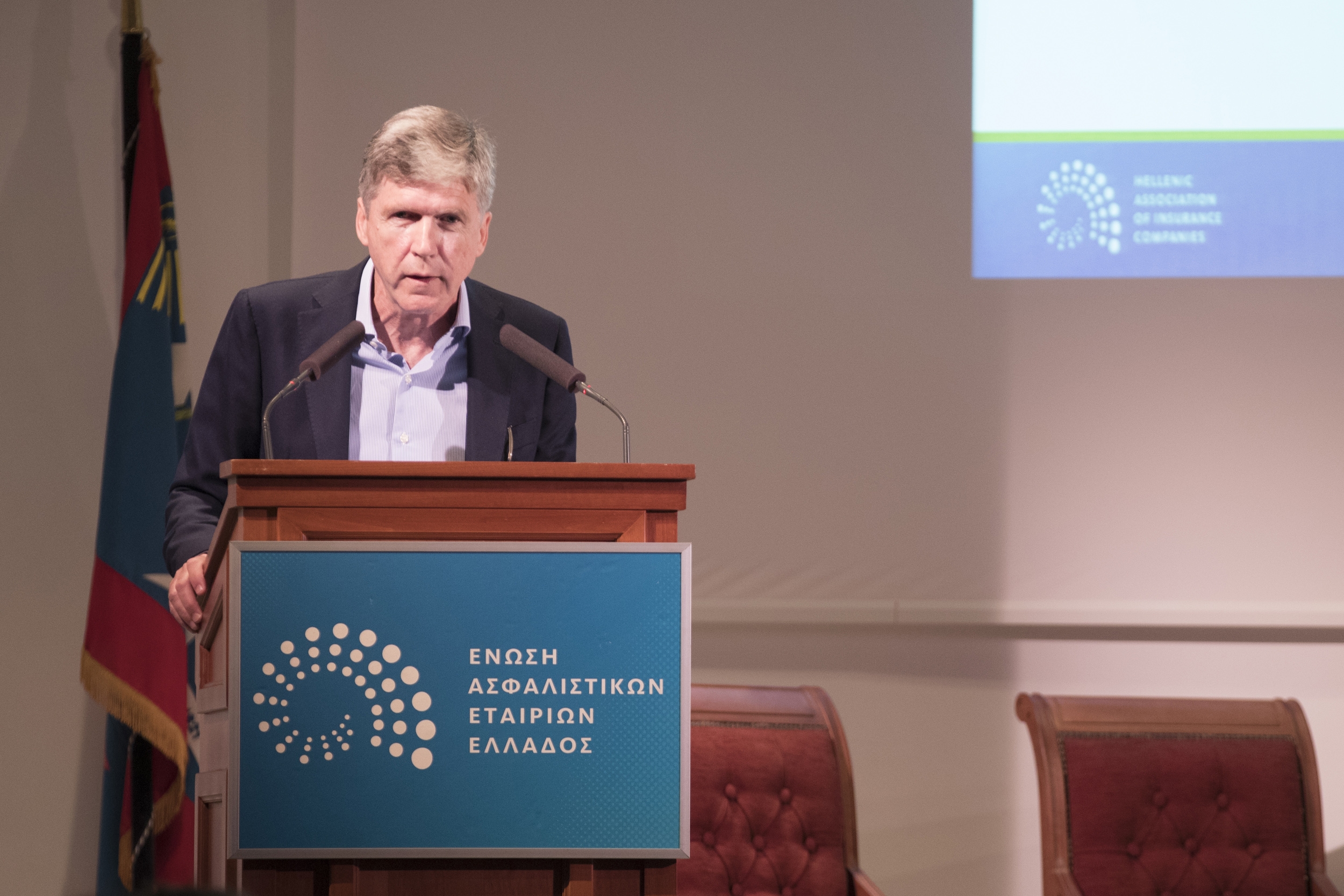
President of the Hellenic Association of Insurance Companies (HAIC) Alexandros Sarrigeorgiou delivered the main speech at the 21st Insurance & Reinsurance Meeting held September 25-27 on the island of Hydra.
Counting 21 successful years, the meeting is a leading European event dealing with current insurance issues and giving the opportunity to insurers and reinsurers to have fruitful business meetings in an outstanding environment.
This year’s program allowed participants to have more free time for networking and meetings.
Below is the complete speech:
“Mr. Minister, ladies & gentlemen,Dear Friends,
On behalf of the Hellenic Association of Insurance Companies, I welcome you to the 21st insurance and reinsurance meeting that this year is back home on the beautiful island of Hydra-where it all started 21 years ago.
We are looking forward to an interesting session ahead, where we will have the chance to discuss the opportunities and threats our market is facing. The world around us, more so than in recent decades is at a turning point. We are facing critical challenges on social, environmental, economic, political and technological fronts. Challenges that appear and mutate with alarming speed.
Our world, as a secure and healthy environment in which to live and grow, is facing multiple interrelated challenges; international relations, climate change, natural catastrophes, social upheaval and reaction to new social norms. And last but not least, persistent slow growth in large parts of the developed world resulting in a financial market environment we have never seen before and here I am referring to negative interest rates. In particular it is as if financial gravity has been suspended and we have to learn how to live with it. In this world, the insurance & reinsurance market must adapt so as to be able to continue to be relevant, i.e. to provide people with the security they need to live and work. This is our mission.
I will very briefly touch on some of the biggest challenges facing the insurance and reinsurance industry today:
1) Technology: in a fast moving world, customers demand relevant insurance covers, fast, cheap and transparent. Traditional insurance & reinsurance providers must adapt quickly now on the expense and communication front, while traditional insurance intermediaries must redefine their role. I’m afraid we are still operating in old and expensive ways. All of us must learn to live with smaller margins.
2) Big Data & Analytics are key into approaching the right people with the right product at the right time in the right way. And given that big data is gathered by organizations who are not in the insurance business, the question becomes not whether but when they might get into our business and in which way we can effectively cooperate with them and /or react.
3) Regulation and Supervision: Solvency II, IFRS 17, IFRS 9, GDPR, IDD & PRIIPS and multitude of other regulations seek to protect the consumer while making insurance more expensive and return on equity in insurance lower for investors. Yes, capital is abundant in insurance and reinsurance but returns are dropping. While no one can argue against the need for proper regulation and standards, the continued one-way move to more regulation will render the position of traditional insurers untenable. And since there is no void in nature, this position may be filled by questionable unregulated operators. We insurers, and regulators must seek for middle ground.
4) Last but not least more and more we are facing challenges such as low for long negative interest rates, which are already here, the inverted demographic pyramid, natural catastrophes and climate change, cyber risk.
These seem to be all coming together in what looks like a perfect storm but at the same time a perfect opportunity where services are most needed by society. So how do our markets look?
Facing all these in our home Europe, we have an insurance market that is the 3rd largest in the world behind Asia and North America, with GWP 1.213 € billion or 1.469 $ billion and market share 29,6%.
The latest 2017 figures are showing a healthy growth rate of 4,7%.
In closing a few words about Greek insurance market:
Per capita insurance premium is only 368 € vs the European average at 2.030 € -remains very low-.
2018 show our market grow modestly by 2% and the 1st half of 2019 at a better clip of 3,9%. Both of these numbers are above GDP growth in the country, which is also improving.
Regarding Greece we should keep in mind one more message: the Greek insurance industry fully adapted and complied to Solvency II, and this during the years of intense economic crisis.
Our market has all the prerequisites to assume a greater role in the economy: we have know-how, experience, human resources, capital, supervision and a European passport.
Mr. Minister, Mr. Mytarakis,
We are welcome you here today and we are very happy that the new government sees the private insurance industry as an important partner to social insurance in areas such as the 3 pillar pensions system and health as well as property protection and natural catastrophes.
We have noted with excitement the declaration of the government of the plans for incentives for private insurance. It’s dangerous that we are the least insured people in pensions, health and earthquake. We cannot afford to remain uninsured.
We believe that growth of the Greek insurance market which already is the largest institutional investor in the country (14,5 billion in investments) can and will fuel further economic growth.
We are here, willing, ready and able to constructively work with the State in seeking a way forward that will help both the economy and the man on the street and we look forward to working with you.
Ladies and Gentlemen,
I wish you a productive as well as an enjoyable stay in Hydra.
Thank you very much.”
The EIB Board of Directors’ first ever meeting in Zagreb highlights ongoing support to Croatian economy

– EIB Board of Directors meets in Zagreb, Croatia to extend EU Bank`s support for the upcoming historic first-ever Croatian presidency of the European Council;- EIB President Werner Hoyer meets Croatian Prime Minister Plenkovic;- In the first nine months of 2019 EIB has supported projects in Croatia with EUR 342.5 million of finance.
In the first nine months of 2019, the European Investment Bank (EIB) supported projects in the Republic of Croatia worth EUR 342.5 million. The EU Bank invested EUR 212.2 million in Croatian small and medium businesses, the backbone of national economy, and in the process sustained more than 47,500 Croatian jobs. Since 2001 total EIB lending in Croatia has surpassed EUR 6 billion.
President of the EIB Werner Hoyer presented the figures to the Croatian Prime Minister Andrej Plenkovic at a meeting on Tuesday in Zagreb, and reviewed the EIB’s activities in the country. The upcoming Croatian Presidency of the European Council was also on the agenda; it is the historic first for the country and the European Union it joined in 2013.
President of the EIB, Werner Hoyer said, “The EIB will continue to provide concrete, hands-on support to Croatia, working alongside our partners in the Croatian Government and within the business community, to strengthen sustainable growth and employment in the country. We are very proud of the way EIB serves Croatian citizens and their economy and the Bank is thankful to our local partners such as HBOR for their support in this process. I am very happy to see the high level of support EIB enjoys from the Croatian authorities in tackling the major challenges of today, including climate change – which is a top priority for the EIB”.
Prime Minister Andrej Plenkovic said, “We are proud to say that that cooperation with EIB has a long-reaching positive effect on Croatian economy, since it stimulates SME growth, export growth, development of new products and technologies as well as improvement of infrastructure. In that respect, cooperation of EIB and HBOR, as a most important local partner, significantly contributed to rising economic needs through a total of EUR 3 billion EIB lending to HBOR since 2001”.
One of the flagship projects for the EIB is the cooperation with the KBC Rijeka, a leading hospital and university center in the third largest city in Croatia. Based on both advisory assistance to prepare complex project documentation and EUR 50 million loan, around 600,000 citizens of Croatia gravitating around the hospital will have their Clinical Centre and University Hospital improved. With Rijeka being a major tourist destination, the project will also translate into quality healthcare for millions of Europeans visiting Croatian seaside.
The President and the Prime Minister met during the EIB monthly Board of Director`s two-day meeting in Zagreb. Together with the Board of Governors and the Management Committee the Board of Directors is one of the three decision making bodies of the EIB. The Board`s meets in Zagreb in the eve of the upcoming Croatian Presidency of the European Council due on January 1, 2020.