
Gazprom Neft has completed construction of Russia’s first LNG bunkering vessel
Construction of Russia’s first ever bunkering vessel – for natural gas (LNG) refuelling of cargo and passenger ships – is now complete: the final stage of building the Dmitry Mendeleev having involved testing of gas and cryogenic (freezing) equipment, loading systems, and LNG storage and offloading pumps and compressors. The vessel will shortly begin its maiden voyage towards its fixed berthing in the Baltic Sea.
This bunkering vessel, named after the great Russian chemist Dmitry Mendeleev, will provide ship-to-ship LNG transportation and refuelling at ports throughout the Gulf of Finland and the Baltic Sea – including St Petersburg, Ust-Luga, Primorsk, Kaliningrad and Vyborg.
Anatoly Cherner, Deputy Chairman of the Management Board, Gazprom Neft:
“LNG is going to play a key role in the decarbonisation of maritime transport, in the medium term. Thanks to its high environmental and performance features, LNG is set to take a significant market share in sales of marine fuels in international shipping. In successfully implementing Russia’s first project to build an LNG bunkering vessel, Gazprom Neft has, effectively, created a new market sector for the country – in marine gas motor fuel – from scratch. This year will see us starting commercial LNG operations in the Baltic region.”
The vessel is 100 metres in length, 19 metres wide, and can transport up to 5,800 m3 of liquid natural gas. Its Arc4 ice-class reinforced hull means it can navigate one-year-old ice (of up to 80 cm thick). The latest shipbuilding and LNG transportation technologies have been utilised on the Dmitry Mendeleev project, in line with the most recent environmental standards governing maritime transport and LNG refuelling processes. The Dmitry Mendeleev is also environmentally friendly, in that it will be using tank-return gas (TRG or “boil-off” gas) from transported cargo as fuel for its onboard power plant. All LNG-bunkering equipment is fully compliant with MARPOL and ECO-S environmental standards. Its integrated digital system means the vessel can be controlled by just one crew member, directly from the navigation bridge.
“K” LINE commenced technical management of Singapore’s first LNG Bunkering Vessel “FUELNG BELLINA
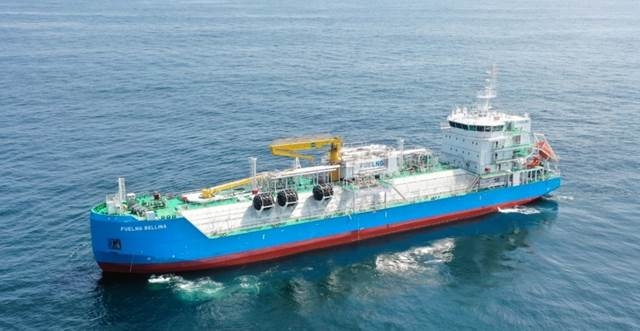
K Line is pleased to announce that it has successfully commenced technical management of Singapore’s first LNG bunkering vessel “FUELNG BELLINA” owned by FueLNG Pte Ltd, a joint venture between Keppel Offshore & Marine Ltd (Keppel O&M) and Shell Eastern Petroleum (Pte) Ltd. The vessel has now become commercially operational in Singapore and is ready to supply LNG as marine fuel.
Singapore is one of the busiest bunkering locations on the globe. FUELNG BELLINA’s debut in Singapore is a remarkable milestone for the maritime industry in their efforts to reduce emissions of greenhouse gas (GHG). LNG enables vessels to emit less GHG when used as marine fuel compared to conventional heavy fuel oils; and having the FUELNG BELLINA provide LNG bunkering on a ship-to-ship basis in Singapore offers more opportunities to various ship operators to choose a greener marine fuel.
The company is proud to get involved in this meaningful event through its technical expertise on ship management of liquefied gas carriers.
The company will promote the effort to reduce GHG emissions in accordance with the “K” LINE Environmental Vision 2050, providing logistics services that are more environmentally low-loaded and highly efficient.
Greece: Financing agreement for the construction of the first LNG bunkering vessel for maritime use in Eastern Mediterranean

Public Gas Corporation of Greece SA (DEPA) and the European Investment Bank (EIB) signed an agreement to finance with up to EUR 20 million the construction of a new LNG bunkering vessel for maritime use in Greece, which will be based in Piraeus.
With a capacity of 3,000 cubic metres of LNG, the vessel, which is the first of its kind in Greece and the Eastern Mediterranean, will be supplied with LNG at Revithoussa LNG terminal and will refuel ships both in Piraeus and other ports in Greece and the wider region, supporting the shift towards green shipping with more environmentally friendly fuels, in line with the new more stringent international regulations.
The agreement was signed by Konstantinos Xifaras, Chief Executive Officer of DEPA, and Andrew McDowell, EIB Vice-President, in the presence of the President of the Board of Directors of DEPA, Ioannis Papadopoulos, who said:
“The new financing from the EIB, the largest investment arm of Europe, is yet one more vote of confidence to the growth prospects of the Greek economy and confirms the significant improvement of the investment climate. It comes in support of a crucial investment in the area of natural gas, which is at the centre of global developments, and contributes to the transformation of Greece into a regional hub.Furthermore, this is a “green” investment, which paves the way for “cleaner” and more competitive maritime transport in the eastern Mediterranean, contributing to the reduction of the country’s environmental footprint, in accordance with the ambitious targets set by the new National Plan for Energy and Climate.”
The loan is guaranteed by the European Fund for Strategic Investments (EFSI / Juncker Plan) and will cover 50% of the vessel’s construction cost. For the construction of the vessel DEPA has secured an additional amount of EUR 8.9 million from the European Union under the European Action entitled “BlueHUBS”, which is coordinated by DEPA and aims at expanding the use of LNG in maritime transport in the eastern Mediterranean.
Following the signature of the agreement, Mr Xifaras said:
“The new vessel will serve the supply needs not only of Piraeus but also of other Greek ports and it represents one more decisive step in DEPA’s efforts to expand the use of LNG in maritime transport in the eastern Mediterranean, thus creating an integrated and efficient LNG supply chain.
Through targeted investments, such as this one, as well as through multilevel international collaborations, DEPA supports the transition of both big ports and ships in the region to the LNG era, contributing to the protection of the environment and improving the competitiveness of Greek shipping and the ports of our country.”
Mr McDowell, European Investment Bank Vice President, said:
“The European Investment Bank is pleased to work with DEPA to support our shared goals of enabling Green Shipping in Greek and international waters. The new EIB financed vessel will provide an alternative fuel for ships in the Aegean and Eastern Mediterranean.”