
Aon Analyses $2 Trillion of Insurance Premiums to Identify Top Profitable Growth Performers
AON, a leading global professional services firm, has published its latest Profitable Growth research that provides a long-term analysis of re/insurer financials to help identify the best performing companies of the past ten years.
By comparing compound annual growth rates (CAGR) with returns on average equity (RoAE) for 120 re/insurers writing nearly $2T of gross written premium (GWP), Aon identifies the firms that successfully achieved profitable growth through soft and hard market cycles from 2013 to 2024. The data confirms a clear pattern: strategic focus and relevance consistently drive stronger financial outcomes — regardless of market conditions.
Key findings of the study include:
In 2024, the analysis group delivered a 14.7 percent RoAE – this represented a six-percentage point improvement on 2013-2023 average of 8.7 percent. The group’s combined operating ratio (COR) of 93.6 percent was the lowest since 2006 and a 3.4 percentage point improvement on the 10-year average.
In 2024, the group’s GWP increased 7.5 percent to $1.9T. Despite exceeding the 2013-2023 CAGR of 6.4 percent*, this figure represented a third year of decelerating growth rates, from the high of 10.2 percent in 2021.
A high variance in profitability for different property and casualty segments.
For the third consecutive year, the segments with the lowest CORs were those with the most globally diversified portfolios in both insurance and reinsurance, and the most specialised.
Aon’s report “Relevance Through the Market Cycle: Five Strategic Imperatives for Insurers” builds on its former analyses of the seven key characteristics of top-performing insurers across risk appetites:
Speed and agility;
Data and analytics;
Underwriting;
Talent;
Distribution; and,
Capital.
Paul Campbell, global growth leader in the Strategy and Technology Group for Aon, said: “In a market defined by volatility, insurers must embed strategic relevance into every decision to outperform through the cycle. We are collaborating with clients on strategies to become top performing insurers to smooth volatility in financial results, become more relevant to customers and make their firms a more attractive proposition to investors.”
Sherif Zakhary, CEO of Strategy and Technology Group and Inpoint for Aon, added: “Insurers must pivot from product suppliers to performance partners which means being proactive, insightful and deeply attuned to client needs across geographies and sectors. However, legacy operating models, rigid capital structures and siloed distribution strategies are holding some insurers back. This is why Aon’s Strategy and Technology Group has built its data-driven approach and nurtured its talent to create and execute clients plans for resilience and growth.”
Building on its research into top-performing carriers, Aon is recommending five actionable strategies to clients to enhance relevance and competitiveness:
Redefine growth strategy;
Align capital with strategy;
Invest in data-driven decision making;
Understand client and channel needs;
Rethink talent strategy for the next cycle.
The latest update arrives at the beginning of Aon’s Reinsurance Renewal Season, which involves a series of events and strategies designed to help clients achieve profitable growth as the industry approaches the key January 1, 2026, reinsurance renewal period.
IUMI reports rising cargo insurance premiums
The International Union of Marine Insurance (IUMI) reports an increase in the 2021 cargo insurance premium base (from 2020) of 8% to USD 18.9 billion alongside an improvement in overall loss ratios.Speaking at this year’s Chicago conference, Isabelle Therrien, Chairperson of the IUMI Cargo Committee said:
“The cargo market has shown growth in 2021 partly due to a rise in the volume of cargo shipped globally combined with the pricing corrective measure still prevalent in that underwriting year. The much-needed correction has yielded favourable underwriting performance. However, the industry is still facing headwinds as the global supply chain remains volatile and is still dealing with the aftershock of the pandemic while now adding inflationary pressures to the mix.”
Cargo premiums increased in most markets, with China leading the growth in 2021. China now accounts for 14% of the cargo market, with the UK (Lloyd’s of London and the International Underwriting Association) having a 12.2% market share. With 2021 claims starting at a low level due to subdued activity in 2020, loss ratios continue to improve in all markets.
She noted that companies are redesigning and diversifying their supply chains with concepts such as near-shoring, reshoring and friendly-shoring gaining in traction. These developments have the potential to change risk profiles in cargo insurers’ portfolios.
Isabelle Therrien added:
“The pandemic has shown that factors such as stability and reliability when it comes to supply chains, are key to product availability. Our assureds are now also looking at different logistics, transportation and insurance solutions to manage this constantly evolving risk.”Source: IUMI
Vessel Insurance Premiums Jump As JWC Redraws Gulf Of Guinea Risk Area
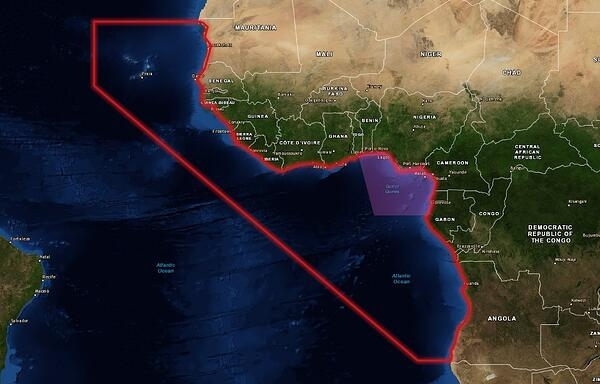
Following an increase in kidnap for ransom attacks in the Gulf of Guinea beyond Nigeria’s economic zone, the Joint War Committee has redrawn the listed extended risk area in the West Africa region.
The Joint War Committee* (JWC) has expanded its Gulf of Guinea listed area further south and east following an uptick in piracy attacks. The JWC’s listed area was last changed in 2013 and previously covered only the exclusive economic zones of Togo, Benin and Nigeria north of latitude 3° north. It has updated the listed areas and now extends between Lome, Togo (6° 6′ N, 01° 12′ E) to a point (0° 40′ S, 03° 00′ E), about 340 nautical miles west of Cape Lopez, Gabon in the south (0° 40′ S, 08° 42′ E).
West Africa VRA JWC
What does this mean for insurance premiums?
A change in the Listed Area allows underwriters to charge more to cover vessels that travel through the region because Shipowners who are required to sail in the Gulf of Guinea will have to obtain the approval of their insurer before they can enter these waters.
Chris Goddard is a leading underwriter of Marine War risks with Vessel Protect. He says additional premiums (AP’s) have increased in 2020 due to a proliferation of piracy in West Coast Africa in both the Marine War and Kidnap and Ransom market.
“The expansion of the Gulf of Guinea notification area is in direct response to the broadening of sustained attacks in the region which began increasing in 2019. The JWC’s decision will increase costs for shipowners operating in the region,” he added.
“However, those who widely adopt best management practice and engage in risk mitigation measures such as transit risk assessments conducted by independent maritime security experts will continue to see preferable insurance terms over their peers.”
Why has the Joint War Committee taken these steps now?
Dryad Global’s analyst, Shannon McSkimming says;
“Attacks in the extended JWC area increased from five in 2017 to 28 in 2019, with 10 of the incidents last year reported as kidnappings. Incidents in the revised area would have made up 30% of all incidents in the JWC West Africa region, had it been implemented last year. The trend that we’ve seen emerging since 2017 coexists alongside a lack of incident reporting in the Indian Ocean. This raises significant questions over the timeliness and responsiveness of the JWC in responding to the evolving nature of the risk and in turn the perceived heightened risk across the region”.
Gulf of Guinea maritime crime stats Jan 1 to Sept 30
Why have “pirates” begun operating at long range in deep waters?
There are a number of historical reports and incidents of Nigerian pirate groups operating at long range and in deep waters beyond Nigeria’s Exclusive Economic Zone (EEZ), but what’s become apparent is that their area of operations has expanded in the past year. The principle driver of such a incidents is the relative lack of effective enforcement in waters neighbouring Nigeria. In addition, pirate action groups seek to capitalise on the opportunities that lie beyond Nigeria’s EEZ where vessels are less likely to be hardened against attack and less likely to have BMP West Africa recommendations in operation. The maritime security threat within the Gulf of Guinea isn’t restricted to Nigeria’s EEZ and as the industry well knows maritime piracy doesn’t adhere to the mapping constraints of conventional national geographic and maritime borders.
Source: Dryad Global