
Pirates board Danish-owned ship in Gulf of Guinea
Pirates have attacked and boarded a Danish-owned ship in the Gulf of Guinea and all communications channels with the vessel are down, a spokesperson for shipping company Monjasa said on Tuesday.
All 16 crew members sought refuge in a safe room onboard the Monjasa Reformer vessel, the spokesperson said.
The Liberian-flagged oil and chemical tanker, which was sitting idle, was attacked on Saturday about 140 miles west of the Republic of Congo’s Port Pointe-Noire.
The vessel is operated by Dubai-based Montec Ship Management, which is owned by Monjasa.
Montec reported the incident to a maritime cooperation centre operated by the British and French navies to maintain safety in the Gulf of Guinea.
The operator is working with all relevant maritime authorities in the region, including several navies, according to Monjasa.
The Gulf of Guinea has become a global piracy hotspot in recent years although cases have fallen there since 2021 as national authorities stepped up security efforts aided by foreign naval ships, according to the U.N. Security Council.
Denmark, which has big commercial shipping interests, deployed a frigate to the gulf in 2021 to protect shipping, but the frigate was pulled back last year after the outbreak of the Ukraine war.
Source: Reuters (Reporting by Jacob Gronholt-Pedersen and Louise Rasmussen, editing by Terje Solsvik and Angus MacSwan)
BIMCO welcomes Danish move on navy in Gulf of Guinea
BIMCO welcomes the appointment of a Danish Special Representative for Maritime Security in the Gulf of Guinea, Ambassador Jens-Otto Horslund.
“While it is understandable that Nigeria does not want foreign navies in their territorial waters, we hope that Ambassador Horslund will be able to garner broad support for an antipiracy operation as mandated by the UNCLOS convention, i.e. in international waters just outside Nigeria’s 12 nautical mile limit,” says Jakob P. Larsen, BIMCO Head of Maritime Safety & Security.
BIMCO has been advocating for collaboration between Nigerian law enforcement and international navies for years.
“It is time for the international community to live up to the aspirations of the UNCLOS convention and suppress the piracy in the Gulf of Guinea, which affects seafarers and companies from all over the world. International navies is an indispensable addition to regional efforts such as Nigeria’s newly acquired Deep Blue capabilities which we hope will reach full operational capability soon,” Larsen says.
BIMCO estimates that two helicopter equipped frigates with robust antipiracy mandates, plus one maritime patrol aircraft working from a base ashore, will have a significant deterrent effect on the pirates operating in the Gulf of Guinea.
Vessel Insurance Premiums Jump As JWC Redraws Gulf Of Guinea Risk Area
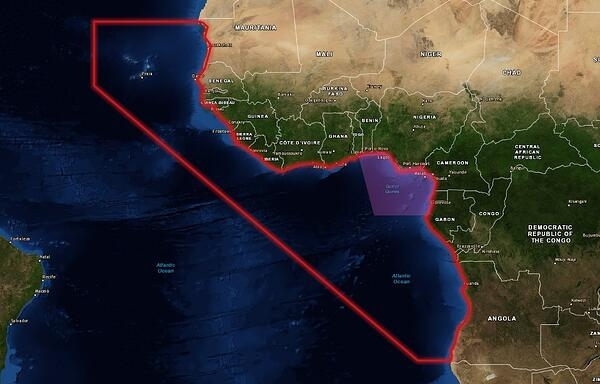
Following an increase in kidnap for ransom attacks in the Gulf of Guinea beyond Nigeria’s economic zone, the Joint War Committee has redrawn the listed extended risk area in the West Africa region.
The Joint War Committee* (JWC) has expanded its Gulf of Guinea listed area further south and east following an uptick in piracy attacks. The JWC’s listed area was last changed in 2013 and previously covered only the exclusive economic zones of Togo, Benin and Nigeria north of latitude 3° north. It has updated the listed areas and now extends between Lome, Togo (6° 6′ N, 01° 12′ E) to a point (0° 40′ S, 03° 00′ E), about 340 nautical miles west of Cape Lopez, Gabon in the south (0° 40′ S, 08° 42′ E).
West Africa VRA JWC
What does this mean for insurance premiums?
A change in the Listed Area allows underwriters to charge more to cover vessels that travel through the region because Shipowners who are required to sail in the Gulf of Guinea will have to obtain the approval of their insurer before they can enter these waters.
Chris Goddard is a leading underwriter of Marine War risks with Vessel Protect. He says additional premiums (AP’s) have increased in 2020 due to a proliferation of piracy in West Coast Africa in both the Marine War and Kidnap and Ransom market.
“The expansion of the Gulf of Guinea notification area is in direct response to the broadening of sustained attacks in the region which began increasing in 2019. The JWC’s decision will increase costs for shipowners operating in the region,” he added.
“However, those who widely adopt best management practice and engage in risk mitigation measures such as transit risk assessments conducted by independent maritime security experts will continue to see preferable insurance terms over their peers.”
Why has the Joint War Committee taken these steps now?
Dryad Global’s analyst, Shannon McSkimming says;
“Attacks in the extended JWC area increased from five in 2017 to 28 in 2019, with 10 of the incidents last year reported as kidnappings. Incidents in the revised area would have made up 30% of all incidents in the JWC West Africa region, had it been implemented last year. The trend that we’ve seen emerging since 2017 coexists alongside a lack of incident reporting in the Indian Ocean. This raises significant questions over the timeliness and responsiveness of the JWC in responding to the evolving nature of the risk and in turn the perceived heightened risk across the region”.
Gulf of Guinea maritime crime stats Jan 1 to Sept 30
Why have “pirates” begun operating at long range in deep waters?
There are a number of historical reports and incidents of Nigerian pirate groups operating at long range and in deep waters beyond Nigeria’s Exclusive Economic Zone (EEZ), but what’s become apparent is that their area of operations has expanded in the past year. The principle driver of such a incidents is the relative lack of effective enforcement in waters neighbouring Nigeria. In addition, pirate action groups seek to capitalise on the opportunities that lie beyond Nigeria’s EEZ where vessels are less likely to be hardened against attack and less likely to have BMP West Africa recommendations in operation. The maritime security threat within the Gulf of Guinea isn’t restricted to Nigeria’s EEZ and as the industry well knows maritime piracy doesn’t adhere to the mapping constraints of conventional national geographic and maritime borders.
Source: Dryad Global