
Intensifying Floods and Droughts Highlight New Era of Climate Risk – Aon Report
AON, a leading global professional services firm, is sharing insights with (re)insurers on the eve of Earth Day on how changing flood and drought patterns are reshaping risk across regions.
The firm’s2026 Climate and Catastrophe Insight (CCI) report, which draws on Aon’s detailed catastrophe data and forward-looking climate modelling, underscores how physical climate risk is evolving and the implications for communities, policymakers and the insurance market. Its analyses show that global economic losses from flooding exceeded $42 billion in 2025 and $2 trillion since 2000.
Drought is also emerging as a major driver of secondary perils, contributing $13 billion in economic losses in 2025 alone. The peril is also responsible for far-reaching secondary impacts across the economy, particularly as energy demand continues to rise.
These dynamics are evident globally and are particularly pronounced in the U.S. Aon’s Climate Risk Monitor projects that U.S. pluvial (rainfall‑driven) flood risk could increase by about 12 percent under a medium‑emissions scenario and roughly 19 percent under a high‑emissions scenario by mid‑century. In 2025, the U.S. recorded 14 separate 24‑hour periods with rainfall amounts equivalent to a 1‑in‑1,000‑year flood – the highest count since 2002 – alongside catastrophic flash flooding in Central Texas and extensive inundation along the Mississippi Valley.
Michal Lorinc, head of catastrophe insight for Aon, said: “Flood has become an increasingly impactful natural hazard over the past three decades, and in response Aon has have developed a wide range of innovative products and coverages to help our clients recover faster and more fully from flood events. Catastrophe modelling is also an area in which we continue to make significant investment, helping to bring clarity to our clients’ flood exposures and thereby aiming to affect better business decisions.”
Recent experience also illustrates the breadth of flood risk globally. Flooding drove China’s highest loss event in 2025, causing an estimated $14 billion in damage, while forward‑looking Climate Risk Monitor projections suggest that other regions, including much of Africa, could face increasing exposure to extreme precipitation and flash flooding.
For policymakers, the CCI report findings highlight the scale of protection gaps and the importance of re‑examining resilience strategies. In the U.S., National Flood Insurance Program (NFIP) data show that in counties receiving NFIP payouts for 2025 flood events, only 2.6 percent of residential structures were covered by NFIP flood policies. At the same time, the number of private home flood policies and the premium paid for these policies more than doubled between 2020 and 2024.
This evolving public‑private mix presents both a challenge and an opportunity. Regulatory frameworks, land‑use planning, building codes and investment in nature‑based infrastructure will all be critical to managing the societal impacts of more frequent flooding, deeper drought and more destructive cyclones.
Andy Neal, managing director of public sector partnership for Aon, said: “Political uncertainty compounds the volatility of natural disasters. For policymakers, coordination between the public and private sectors will be increasingly important to expand coverage, invest in resilient infrastructure and use risk insights to inform planning decisions. Those that act early are better positioned to protect communities and economies over the long term.”
To support both risk transfer and risk reduction, the CCI report highlights the role of innovative mitigation approaches. Nature‑based solutions – such as wetlands and coastal ecosystems combined with traditional defenses – and novel concepts like amphibious housing, which are able to rise on flood waters, are gaining attention as cost‑effective ways to reduce losses before they occur.
Based on the identified natural catastrophe trends, Aon believes stakeholders that proactively integrate forward‑looking climate analytics into planning, underwriting, policy design and investment decisions will be better positioned to navigate a future defined by increased flooding, more severe drought and fewer but more damaging cyclones. The firm is advising (re)insurer clients to review exposure concentrations and expand the use of climate‑conditioned scenarios in underwriting, product innovation and capital strategy.
Liz Henderson, head of climate risk advisory for Aon, said: “Climate variability is increasingly influencing insurers’ business models, and these natural catastrophe trends point to a more structurally complex risk landscape where traditional views of risk, based only on historical experience, are no longer sufficient.”
Aon’s 2026 Climate and Catastrophe Insight report is available here: https://aon.io/3LUFi5A
Hurricanes, severe thunderstorms and floods drive insured losses above USD 100 billion for 5th consecutive year, says Swiss Re Institute
Estimated insured losses from natural catastrophes on track to exceed USD 135 billion in 2024
Hurricane Helene and Hurricane Milton severely impacted the US, resulting in estimated insured losses approaching USD 50 billion
Major floods hit Europe and the Middle East, causing estimated insured losses of close to USD 13 billion as of today
With 1.54°C above the pre-industrial average, 2024 is set to become the hottest year on record. A warming climate favours the occurrence of many of the natural catastrophes observed in 2024. Europe, in particular, has experienced intense flooding in 2024, resulting in the second-highest insured losses from floods in the region ever, according to Swiss Re Institute’s estimates. The US has been affected by two major hurricanes and a high frequency of severe thunderstorms, making up at least two thirds of 2024’s global insured losses of more than USD 135 billion as of today’s estimates.
Balz Grollimund, Swiss Re’s Head Catastrophe Perils, says: “For the fifth consecutive year, insured losses from natural catastrophes break the USD-100-billion mark. Much of this increasing loss burden results from value concentration in urban areas, economic growth, and increasing rebuilding costs. By favouring the conditions leading to many of this year’s catastrophes, climate change is also playing an increasing role. This is why investing in mitigation and adaptation measures must become a priority.”
Flood risk is rising globally
In 2024, severe floods in Europe and the UAE resulted in estimated insured losses of close to USD 13 billion to date. It was the third-costliest year for this peril globally and the second costliest for Europe which experienced insured losses of approximately USD 10 billion, according to Swiss Re Institute’s estimates.
Intense precipitation in April caused floods in the Gulf region, disrupting the operations of the world’s busiest airport of Dubai. In September, Storm Boris caused major floods in Central Europe, mainly affecting the Czech Republic, Poland and Austria. Additional impacts were reported from Slovakia, Romania, Italy and Croatia. While so-called Vb lows – slow-moving, low-pressure systems – are nothing unusual in the region, the strong intensity of the Vb system connected to Storm Boris is favoured by conditions related to climate change. Storm Boris mixed cold Arctic air flowing southwards with unusually warm air from the east and south, drawing moisture from a record-breaking warm Mediterranean Sea.
In October, large parts of Spain experienced heavy rainfall, flash floods and hailstorms, which caused severe damage. The floods were worst in eastern and southern Spain, with most of the damage across the Valencia and Castilla-La Mancha regions. Andalusia and the Balearic Islands were also affected. One year’s average precipitation was dumped in less than eight hours in many locations. Steep clay terrain and drainage systems could not absorb the exceptional amount of water, leading to fast overflows.
Pluvial floods can severely affect urban areas
Floods come in varied forms. The most common are fluvial and pluvial floods, and in coastal areas, storm surge floods. Fluvial floods can happen after periods of heavy rainfall. They usually affect areas close to rivers where flood waves can build up gradually or rapidly and last for a longer period. Pluvial floods can happen anywhere and affect all kinds of (urban) areas. They cause flash floods after extreme rainfall in a short period of time because large parts of soil are sealed and therefore cannot absorb the excess of water as drainage systems are overwhelmed. Floods can also manifest as secondary effects of primary perils. This is the case for tropical-cyclone-induced flooding from storm surge and rainfall.
Jérôme Jean Haegeli, Swiss Re’s Group Chief Economist, says: “Economic development continues to be the main driver of the rise in insured losses resulting from floods, but also other perils, seen over many decades. However, with natural catastrophe risks rising and higher price levels, the annual increase of 5–7% in insured losses will continue, and protection gaps could remain high. This highlights the need for adaptation in combination with an adequate insurance coverage that can support financial resilience.”
Losses are likely to increase as climate change intensifies extreme weather events while asset values increase in high-risk areas due to urban sprawl. Adaptation is therefore key, and protective measures, such as dykes, dams and flood gates, are up to ten times more cost-effective than rebuilding.
2024: Hurricanes and severe thunderstorms, with US hardest hit
At least two thirds of this year’s insured losses are attributable to the US: Two major hurricanes made landfall within a fortnight on the coast of Florida in September and October this year. Hurricane Helene made landfall as a major hurricane on 27 September, followed by Hurricane Milton on 9 October. Insured losses from both hurricanes are expected to amount to below USD 50 billion as of today. Additionally, 2024 experienced a high frequency of severe thunderstorms (severe convective storms, or SCS), which affected mostly the US. Insured losses from SCS are expected to add more than USD 51 billion globally for 2024 as of today, the second-highest loss after the record high of approximately USD 70 billion in 2023.
Table 1: Estimated total economic and insured losses in 2024 and 2023
(USD billion in 2024 prices)
2024
2023
Annual change
Previous10-y average
Economic losses (total)
320
302
6%
254
Nat cat
310
291
6%
241
Man-made
10
11
–8%
13
Insured losses (total)
144
125
16%
108
Nat cat
135
115
17%
98
Man-made
9
10
–7%
10
Source: Swiss Re Institute
Floods in southern Germany – Allianz donates up to two million euros to rescue and relief services
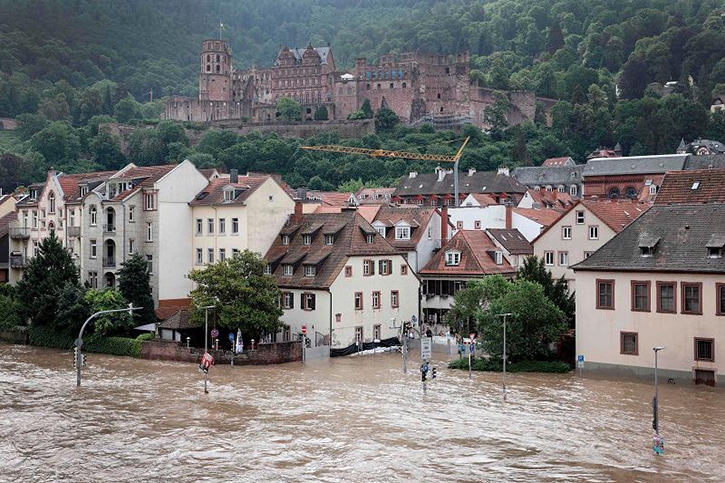
As the leading building and motor insurer in Bavaria and Baden-Württemberg, Allianz is working hard to support affected customers competently, quickly and unbureaucratically
Claim adjustment task force: 600 loss assessors and service providers working on site, 6700 drying devices on their way to flood areas
More frequent weather extremes due to climate change: Allianz emphasizes interplay of prevention, insurance solutions and government support for extreme disasters
Heavy rain, high water and flooding have caused major damage in large parts of southern Germany over the past few days. Allianz is working hard for its customers during the crisis: Specialist claims units and Allianz agencies are supporting customers on the ground, and thousands of drying devices are on their way to the affected regions. Allianz is also donating one million euros to local fire departments, rescue organizations and technical relief services. Allianz will also double its employees’ donations of up to 500,000 euros – an internal donation campaign has already been launched. The employee donation will be handed over to the Red Cross.
In Wertingen, near Augsburg, this Thursday, three members of the Board of Management of Allianz in Germany – Lucie Bakker, Frank Sommerfeld and Jürgen Heinle – get a picture of the situation on the ground and thank the agencies and claims experts for their continuous efforts. Lucie Bakker, Chiefs Claims Officer of Allianz Versicherungs-AG, says:
“Due to climate change, we have to expect heavy rain, storms and floods more and more frequently. But every time we are shocked by the images from the disaster regions, we are stunned by the extent of the devastation and the worries of the people affected are concerning. Above all, our thoughts are with those who have lost family members. As one of the largest building and motor insurers in southern Germany, we at Allianz are mobilizing all our strength and expertise to provide our customers with uncomplicated and rapid support in this exceptional situation. With our donation to the rescue organizations, we are honoring the tireless efforts of thousands of emergency personnel who are saving lives and reducing property damage.”
Even though the acute flooding has receded in most areas, it is still too early to assess the extent of the damage. Where the water has already drained away, around 600 Allianz loss assessors, experts and external service providers are currently working to expertly assess the damage, discuss drying and repair measures and pay out advances. Construction drying equipment is in short supply after floods and is a much sought-after commodity: Allianz has therefore organized around 6,700 additional drying devices and is transporting them to the affected areas. The Allianz Craftsmen Service is also in action and provides Allianz policyholders with professional craftsmen quickly and easily.
A detailed interview with Lucie Bakker on Allianz’s flood claims management can be found here.
Allianz employees are also affected by the flood. These employees can apply for paid leave of 2 to 5 days.
Following the floods in the Ahr valley, the widespread flooding in Bavaria and Baden-Württemberg is yet another reminder that extreme weather conditions are increasing in frequency and severity as a result of global warming. In Germany, the demand for compulsory insurance is being discussed. Allianz believes that a compulsory insurance model alone is not a reasonable alternative. Klaus-Peter Röhler, member of the Allianz SE Board of Management responsible for business in Germany, calls for a coherent overall concept against increasing natural hazards (link to detailed statement):
“We need to arm ourselves against more frequent extreme weather events. Compulsory insurance would not have prevented a single loss. It is also neither solidary nor democratic, because it takes away customers’ freedom of choice. At Allianz, we offer every residential building policy with a natural hazard protection option – a voluntary opt-out must always be possible.
We need an overall concept against natural hazards that is based on three building blocks: prevention and protective measures for climate impact adaptation, risk-appropriate insurance cover and state support for extreme natural disasters. This is the only way we can break the spiral of increasing damage caused by extreme weather events and rising premiums.”