
EUR 200m EIB backing for climate, economic and social cohesion projects across Greece
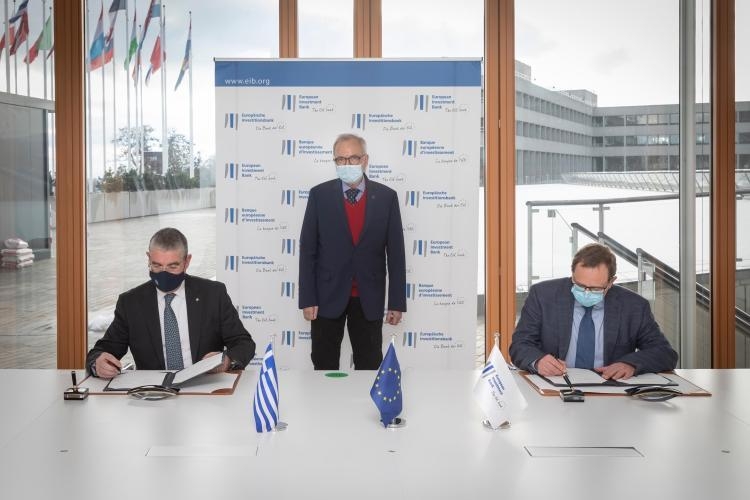
Loan of EUR 200 million to finance the national contribution of 2014 – 2020 Partnership Agreement between EU and Hellenic Republic, with total EIB support reaching EUR 1.7 billion.
Initiative to accelerate small scale innovation, entrepreneurship, clean energy, environmental protection, education and health projects.
Priority investment in high-impact small scale projects across Greece will be accelerated following agreements signed by the Minister of Finance of the Hellenic Republic and Governor of the European Investment Bank, Christos Staikouras, Deputy Minister of Development and Investments of the Hellenic Republic, Yannis Tsakiris, European Investment Bank President, Werner Hoyer and EIB Vice President responsible for Greece, Christian Kettel Thomsen.
The latest contracts were signed during a visit to the EIB headquarters by Minister Tsakiris Luxembourg earlier today.
“Investment to improve health and education, enhance economic opportunities, and strengthen climate action is key for Greece in these challenging times. Today’s new EUR 200 million agreement will contribute to long-term financing and accelerate a green recovery following the COVID-19 pandemic. The excellent cooperation between the Greek authorities and the EIB Group’s Investment Team for Greece is testament to the enduring, intense, positive relationship between the country and the EU Bank.” said Werner Hoyer, President of the European Investment Bank.
This key agreement will enable schemes under the Greek 2014 – 2020 Partnership Agreement between EU and Hellenic Republic to be smoothly financed and increase economic and social impact. The latest EUR 200 million EIB financing represents the final tranche of EUR 1.7 billion European Investment Bank support for the Greek national contribution to EU structural fund backed priority investment across the country, which are co-financed by the EU Structural and Investment Funds. This will enable projects under the EUR 18.6 billion six-year European Union programme to be completed or expanded to increase economic and social impact.
“EUR 1.7 billion support from the European Investment Bank is speeding-up and making best use of European Union structural funds to strengthen the competitiveness of Greek companies, promote entrepreneurship, improve skills, better protect the environment, complete climate mitigation projects and ensure that priority projects are completed. Today’s new EUR 200 million agreement follows the successful use of earlier financing and will help to complete schemes of national importance.. The close partnership between Greece and the EIB’s Investment Team for Greece is delivering new opportunities and substantially contributing to Greece’s strong, sustainable and inclusive recovery from the health, social and economic challenges of COVID-19”, said Christos Staikouras, Minister of Finance of the Hellenic Republic and Governor of the European Investment Bank.
“The European Investment Bank is a key partner for Greece and supports transformational public and private investment across the country. Today’s EUR 200 million agreement completes EIB backing for the 2014-2020 EU investment and follows successful implementation of hundreds of projects under the 2014 – 2020 Partnership Agreement. The Ministry of Development and Investments, having the role of coordinator in matters of investments, financing and development, is committed even more to enhance further the cooperation with the EIB”, said Yannis Tsakiris, Deputy Minister of Development and Investments of the Hellenic Republic.
Unlocking high impact investment across key sectors
Confirmation of EIB financing will accelerate crucial investment in research and innovation, communications, sustainable transport, water, waste, renewable energy and energy efficiency, health, education and urban regeneration projects across Greece.
Enhancing climate action in Greece
More than 25% of the projects will reduce climate emissions and reduce the impact of climate change and help Greece to contribute to global climate goals.
This includes schemes to cut energy bills and carbon emission by improving energy efficiency, smart energy distribution and improving water management.
Increasing EIB cooperation with Greek authorities
During the visit to the EIB the Deputy Minister of Development and Investments, responsible for Public Investment and Structural Funds in Greece, discussed ways to increase technical cooperation with the EIB to enhance the impact of future investment in the country with President Hoyer, Vice President Kettel Thomsen and the EIB’s dedicated Investment Team for Greece.
ING reports its climate alignment score for its shipping portfolio for the first time under the Poseidon Principles

Banks have an important role to play in promoting sustainable development. Within the shipping sector, the approach to sustainability was fragmented among different financial institutions. Driven by leading shipping financiers, in June 2019, the Poseidon Principles became the first sector-specific climate alignment agreement for financial institutions. Today, ING and 14 other signatories deliver on their commitment and publish the Poseidon Principles Annual Disclosure Report 2020 (PDF, 1.9MB).
The Poseidon Principles established a global framework to quantitatively assess and disclose whether financial institutions’ lending portfolios are in line with climate goals set by UN maritime agency, the International Maritime Organization (IMO). The IMO’s initial greenhouse gas (GHG) strategy prescribes that international shipping must reduce its CO2 emissions compared to 2008, by 40% in 2030 and 70% by 2050, while pursuing efforts towards phasing them out as soon as possible in this century.
“I am delighted to report our first portfolio result under the Poseidon Principles aligns with the IMO pathway. This reflects our focus on lending to first class owners and financing modern assets. However, this is only the start and I look forward to cooperating with the Poseidon Principles Signatories and clients to ensure that the industry meets the IMO 2030 and 2050 targets,” said Stephen Fewster, global head of Shipping Finance and Treasurer of the Poseidon Principles Steering Committee.
During the last 18 months, the global shipping team has been engaging with clients in order to collect CO2 emissions data needed to report our score. It is encouraging to see that our clients welcomed this initiative, demonstrated by the fact that 87% of them shared their CO2 emissions data.
Going forward we will look to assess the carbon footprint of each vessel we finance as part of our overall assessment. This is not to say we won’t finance vessels that don’t meet the IMO trajectory, but we will use the data to engage in constructive discussions with clients and assist them in taking the required steps in order to make progress towards meeting the IMO targets. This approach fits with our goal of being a long-term, reliable and trusted partner. The Poseidon Principles fit perfectly with our Terra approach, our strategy to steer our portfolio towards the Paris Agreement’s well-below two-degree goal. In the recently published second Terra approach progress report (PDF, 11.2MB), we give details on all our nine carbon intense sectors in scope.
Global Climate City Challenge: 5 cities selected as climate leaders to receive technical support from the European Investment Bank
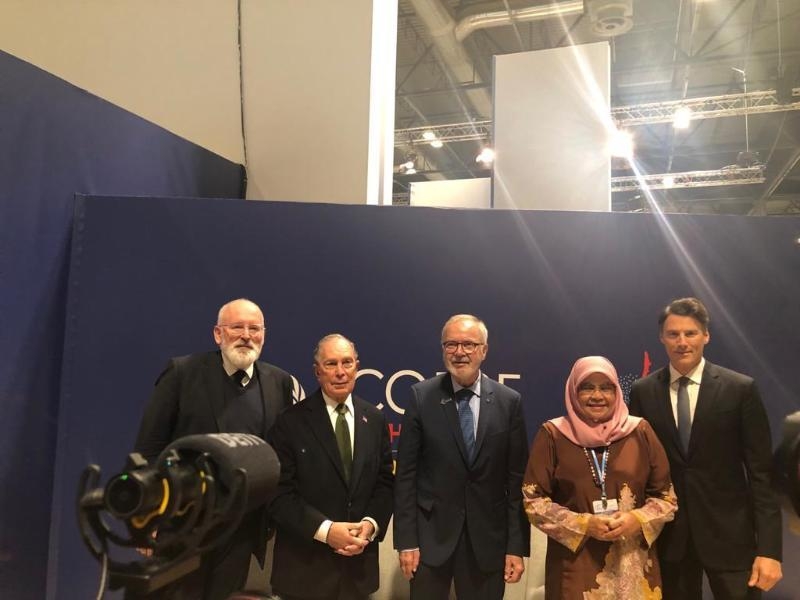
At the UN Climate Change COP25, five frontrunner cities have been selected for their ambitious and potentially transformative urban climate projects that could receive technical support from the European Investment Bank (EIB) to get their projects off the ground. The projects focus on critical urban climate action including improving waste management, cutting river and ocean pollution, sustainable urban transport, greening urban spaces and enhancing urban resilience to the effects of climate change.The following cities: Cotonou (Benin), Makindye (Uganda), Monastir (Tunisia), Jambi (Indonesia) and Recife (Brazil) now qualify for the next phase of the Global Climate City Challenge (GCCC), a partnership between the Global Covenant of Mayors and the European Investment Bank endorsed by the European Commission. They serve as role models for climate action in key sectors and cities in the Global South.The Global Climate City Challenge was launched in September 2018. From an initial 140 projects and 100 applicant cities these five have emerged as the frontrunners. Urban finance and climate experts are now working with municipalities and their partners in order to scope out the details of their project needs. If successful, the projects will generate important social and environmental co-benefits.
“The Commission is making the European Green Deal its number one priority,” said Frans Timmermans, newly appointed Co-Chair of GCoM and European Commission Executive Vice President for the European Green Deal. “The European Commission is proud to endorse this step forward in accelerating local climate action, not only in Europe but across the world.”
EIB President Werner Hoyer said, “Cities need support in getting their climate projects off the ground and, as we strengthen our role as the EU’s climate bank, we at the EIB need great role models. In that respect The Global Climate City Challenge, our partnership with GCOM, is immensely important: it showcases climate leaders like the 5 announced today but also helps identify what is really needed locally to make them bankable, improve the lives of local people, and tackle climate change.”
Former New York City Mayor and Co–Chair and Co-Founder of GCoM Michael R. Bloomberg said: “There are more than 10,000 cities in the Global Covenant of Mayors, and together they are home to a huge number of promising ideas. The Global Climate City Challenge will help turn the best ideas into real policies that improve people’s lives – and spread from city to city.”
“The recognition of Recife by the EIB and GCoM, among hundreds of projects from all over the world, comes at a very special moment after hosting the Brazilian Climate Conference and officially declaring the global climate emergency,” Geraldo Júlio, Mayor of Recife, Brazil and president of ICLEI South America’s Regional Executive Committee said. “We are motivated to work through this technical assistance in order to accelerate the climate agenda in Recife and also to inspire other local governments across the region.” Mondher Marzouk, Mayor of Monastir, Tunisia said: “We have no shortage of ideas in our climate action plan but access to finance is instrumental to getting projects out our of pipeline and on to ground. The time to be ambitious in urban climate action is now—and we in Monastir are ready to act.”
More about the projects:
Cotonou, Benin, is striving to improve its waste management infrastructure and improve recycling and collection processes, fostering the creation of green jobs and entrepreneurship in the sector and reduce the amount of plastic discharge in its coastal lagoon.Makindye, Uganda, leads of a consortium of 4 municipalities in the Greater Kampala area and are developing a comprehensive climate action programme mainly focused on integrated waste management but including also energy efficiency and urban green areas.Monastir, Tunisia, is looking at ways to integrate nature-based solutions to enhance the city resilience, in particular in the city’s coastal area which is particularly vulnerable to climate change impacts.Recife, Brazil, focuses on the rehabilitation and expansion of an existing urban park alongside a riverbank to improve sustainable mobility, reduce the risk of flooding and impact of heat waves while also contributing to carbon sequestration.Jambi, Indonesia, is looking at ways to improve its traffic congestion in a climate-friendly way for instance by introducing of electric buses.
The GCCC is part of an overall strategic approach to help cities realise their climate action ambition. The GCCC challenge has revealed a greater need for early stage project support for cities to define their climate action projects and get them off the ground. It illustrates exactly why there is a need for the planned City Climate Finance Gap Fund, which will provide funding to prepare pre-feasibility studies and other support at the early stages of project preparation.
The new Cities Climate Finance Gap Fund was announced as part of the Leadership in Urban Climate Investment (LUCI) initiative launched in September at the United Nations Secretary General’s Climate Action Summit in New York by EIB President Hoyer. The Gap Fund is co-funded by Germany and Luxembourg and is co-developed with GCOM.