
Generali and UNIDO partner to promote the sustainable development of coffee production in Africa
Generali and the United Nations Industrial Development Organization (UNIDO) have today signed a joint declaration under the ACT Programme (Advancing Climate-Resilience and Transformation in African Coffee) to promote sustainable coffee production in Africa. The collaboration aims to strengthen international partnerships and technical cooperation to improve socio-economic conditions, enhance climate resilience, and support local value addition in key coffee-producing communities.Funded by the Italian Ministry of Foreign Affairs and International Cooperation (MAECI) within the framework of the EU Global Gateway and Italian Mattei Plan priorities, the ACT Programme is led by UNIDO in partnership with the International Coffee Organization (ICO) and the Inter-African Coffee Organization (IACO) and private sector partners.The initiative focuses initially on Ethiopia, Kenya, Tanzania, Uganda, and Malawi, applying a five-pillar approach: value addition, climate, compliance, research, and social inclusion, with finance as a cross-cutting enabler.Andrea De Marco, Programme Manager and Partnership Advisor at UNIDO, said: “Through UNIDO’s ACT Programme, we are building resilient and sustainable agricultural value chains that create inclusive employment opportunities, add value locally, and protect our planet. The partnership with Generali is a strong example of how public and private actors can join forces to make this transformation a reality. Together, we aim to strengthen the livelihoods of coffee producers in Africa, enhance climate resilience, and promote fair and sustainable global trade in agricultural commodities.”Lucia Silva, Group Chief Sustainability Officer at Generali, said: “The growing impact of climate change on agricultural production worldwide, including coffee production, is undeniable. In this context, insurance plays a critical role in strengthening climate resilience – particularly in developing economies that are more vulnerable to climate impacts. Addressing this global challenge requires a joint effort. Generali is proud to partner with UNIDO to promote solutions such as parametric insurance, supported by the expertise of Generali Global Corporate & Commercial. These solutions enhance the resilience and sustainable development of coffee production in Africa and help bridge the protection gap amid ever-increasing climate risks.”The partners will focus their collaboration on three key areas:
Promoting multi-stakeholder partnerships and public-private cooperation to mobilize resources and share knowledge for inclusive growth;
Conducting joint studies with emphasis on parametric insurance for the coffee value chain in the African context;
Fostering dialogue and impact measurement among public and private stakeholders, including practical tools for assessing social and environmental outcomes.
Within this initiative, funded by the Italian Ministry of Foreign Affairs and International Cooperation (MAECI) under the EU Global Gateway and Italian Mattei Plan priorities, UNIDO acts as programme lead in partnership with the International Coffee Organization (ICO), the Inter-African Coffee Organization (IACO) and private sector partners. Generali, leveraging the expertise and capabilities of Generali Global Corporate and Commercial (GC&C), the Group’s centre of excellence for parametric insurance, supports the project as technical advisor.
Generali’s broader commitment to fostering sustainability and resilience
In the Group’s “Lifetime Partner 27: Driving Excellence” strategy, sustainability is even more embedded into Generali’s core business and operations, aligning with the commitment to be a responsible insurer, investor, employer and corporate citizen. As part of this commitment, the Group has a strong focus on public-private partnerships and on using its expertise to support public bodies in fostering sustainability and resilience. This includes the multi-year partnership between Generali and the United Nations Development Programme (UNDP) to enhance the financial resilience of vulnerable communities, MSMEs, and global value chains to climate and other risks. Furthermore, Generali is also part of the Insurance Development Forum’s (IDF) Blueprint for Infrastructure Resilience Development with the aim to facilitate insurance sector investments in infrastructure that strengthen the resilience of vulnerable communities in emerging countries against climate change-related risks and other natural disasters.
German, African and international political, business, development and finance share green investment best practice and solutions for sustainable development in Africa
Berlin hosts EU-Africa Green Talk to share development solutions
Dialogue between European Investment Bank, Portuguese Embassy in Berlin, financial community and development stakeholders confirms importance of green investment
Ministers of State for Foreign Affairs from Germany and Portugal and EIB Vice President Thomas Östros today joined more than 80 business leaders, diplomats from Africa and Europe, financial experts, and development specialists at the Berlin Green Talk to share investment best practice and outline how to accelerate the green transition in the context of EU-Africa relations.
“Germany and the European Union are committed to working with public and private partners to deliver sustainable development and create opportunities from the green transition in Africa. Recent innovative investment across Africa has harnessed renewable energy, ensured access to finance and secured supply of clean water for millions of people. Today’s Berlin Green Talks allow innovative ideas and technical best-practice to be shared and strengthen the impact of future investment. Germany welcomes participants to today’s Green Talk and thanks the Portuguese Presidency of the European Union and the European Investment Bank for their engagement with African and European partners Together we can accelerate the green transition in Africa.” said Niels Annen, Minister of State at the Federal Foreign Office of the Federal Republic of Germany.
“Africa and Europe are committed to accelerating the green transition and delivering sustainable development. The Berlin Green Talk, bringing together partners to share technical, financial and environmental expertise, is essential to accelerating new investment that delivers both a stronger recovery after the pandemic and a greener future for Africa and Europe. Over recent weeks the Portuguese Presidency of the Council of the EU and the European Investment Bank (EIB) have brought together thousands of experts in Green Talks across Africa and Europe ahead of the EU-Africa Green Investment Forum in Lisbon next week.,” said Francisco André, Portuguese Secretary of State for Foreign Affairs and Cooperation.
Participants, including representatives of the German Development Institute, Federation of German Industries and Siemens highlighted how innovation and close cooperation can scale up clean energy, sustainable transport and business investment in Africa. The green transition was highlighted as a unique opportunity that can both create economic opportunities and strengthen economic resilience to COVID-19, as well as increasing protection from a changing climate and enabling more sustainable use of resources.
“Today’s Berlin Green Talks bring together private and public partners from across Germany, Europe and Africa. This will ensure a more sustainable future for this planet and its people. The Portuguese EU Presidency and European Investment Bank are pleased to join forces with German business, political and conservation partners to learn from each other and ensure that lessons learnt in Germany, Europe and Africa can enhance sustainable development around the world. Together we share a common goal of accelerating and increasing sustainable investment that both unlocks economic and social opportunities.” said Thomas Östros, European Investment Bank Vice President.
“Partnership between Africa and Europe is key to increasing investment that is essential to combat climate change and to create new opportunities. The impressive examples of successful sustainable investment discussed at the Berlin Green Talks today will be shared with African, European and global green leaders in Lisbon next week.” said Francisco Ribeiro de Menezes, Ambassador of Portugal to Germany.
The virtual dialogue, organised by the European Investment Bank and Portuguese Embassy in Berlin, is one of more than 25 events being held across Africa and Europe ahead of the High-Level Green Investment Forum taking place in Lisbon on 23rd April.
EIB confirms €3 billion of new investment across Africa in 2019
– 60% of EIB financing supported private sector – creating jobs and helping African business grow.
– Direct engagement in 22 African countries – new sustainable transport, renewable energy, access to clean water and agriculture projects.
– Targeted financing -unlocking gender, digital, local currency lending and clean ocean investment.
– High impact financing- addressing challenges of fragile states and regions vulnerable to climate change.
– New cooperation with philanthropic, UN and development finance partners across Africa
– €4 billion of new financing for African investment expected in 2020.
Last year, the European Investment Bank (EIB) provided €3 billion of new financing that will support €10.7 billion of transformational investment across Africa.
“Africa is a key priority for the European Union and the European Investment Bank. The European Investment Bank is committed to working with African partners to accelerate and expand new investment that delivers sustainable development, tackles the climate emergency, creates jobs and improves lives across Africa. The €3 billion of new investment in Africa supported by the EU bank in 2019 builds on 57 years of engagement across 52 African countries. In recent months, the EIB has launched pioneering new initiatives to accelerate new investment essential to enabling women to fully participate in economic activity under the pioneering SheInvest programme, to ensure African innovation companies can expand and to combine our financial understanding with philanthropy to tackle malaria. said Werner Hoyer, European Investment Bank President
The EU bank’s engagement in Africa will enhance economic opportunities, accelerate sustainable development, ensure access to finance, communications, clean water and clean energy for millions of people across the continent, and be reinforced with European Union engagement and policy priorities.
“The impact of EIB engagement in Africa is enhanced by our unique global technical, sector and financial experience, the expertise of EIB teams in our nine African offices and close cooperation with local project partners,” added President Hoyer.
Supporting investment across Africa
The European Investment Bank, the European Union’s long-term lending institution, directly supported 58 new investment projects located in 22 African countries and, in cooperation with both African and international financial partners, backed projects in many other countries across the continent through regional financing programmes.
“The EU bank is continually increasing the impact of investment that supports sustainable development and addressing climate change in Africa. New support confirmed last year is providing thousands of schools and health centres with reliable electricity for the first time, ensuring that African farmers in the Sahel, eastern and southern Africa can access finance, providing clean water for millions of people in the Sahel and Southern Africa, and upgrading sustainable transport in Africa’s largest city and the island state of São Tomé and Príncipe. The EIB also agreed new cooperation with experienced African financial institutions that is delivering hundreds of small-scale clean energy, digital, education, health and micro-finance schemes across the continent. By sharing technical, business and banking expertise through training programmes, the EIB is making it possible to strengthen the skills of thousands of African entrepreneurs and financial professionals.” said Ambrose Fayolle, European Investment Bank Vice-President responsible for development.
EIB expected to increase Africa financing to €4 billion in 2020
Looking ahead, the EIB expects to significantly increase engagement in both sub-Saharan and North Africa and to provide €4 billion to support public and private investment across the continent in 2020.This will include increased support for infrastructure that drives private sector growth, enabling job creation by entrepreneurs, start-up companies and corporates, and new financing for climate related investment and sustainable development.
Combining technical, financial and political engagement to support high-impact sustainable investment in Africa
In recent years, alongside close technical and financial cooperation with the European Commission, the EIB has provided more than €12 billion for new financing in Africa in cooperation with international and European development finance partners, including the African Development Bank, World Bank and EBRD, as well as Dutch, French and German development finance agencies.
The EIB is also working closely with UN Habitat to improve water infrastructure in communities around Lake Victoria, UNHCR to ensure refugees can access finance in Uganda, and UNIDO to support private sector development.
Enabling private enterprise to flourish, innovate and create jobs
Last year, the EIB provided more than €1.8 billion to support private sector investment across Africa, representing 60% of overall engagement on the continent.
This included €500 million of new dedicated support for African start-up companies’ engagement in digital, agribusiness, financial inclusion and health services.
New EIB cooperation with African corporate, banking and micro-finance partners is providing specialist financing for smallholder farmers, removing local currency costs holding back investment and helping private companies invest in climate adaptation.
New private sector financing programmes were agreed with leading local bank and micro-finance partners that include dedicated financing intended to reduce gender inequality, provide long-term financing in local currency and target tailor-made financial products for agribusiness
Strengthening economic and climate resilience to benefit vulnerable communities in fragile regions and least developed countries
In recent years, the EIB has provided more than €2 billion of new financing to support high-impact investment in fragile states and least developed countries across Africa.
Last year the EIB agreed new support to provide first-time telecommunications coverage to remote rural regions in West Africa and ensure that rural regions in the Sahel can access micro-finance. The EIB also agreed to support new projects to develop off-grid solar in Mozambique and Malawi, better protect coastal roads in the island state of Sao Tome and secure the supply of clean water for 2.2 million people in the Madagascan capital following recent typhoons.
The EIB also agreed to help to pave the Mano River Union Road that will reduce seasonal closures after heavy rain, enable hundreds of thousands of people living in local communities to access markets and healthcare, and strengthen trade links between northern Liberia, Guinea and Côte d’Ivoire.
Ensuring global financial and technical expertise benefits Africa
The EIB ensures that technical, environmental, social and financial expertise and sector understanding is shared with project promoters, financial partners and the private sector.
In 2019, the EIB successfully completed training programmes for more than 4 000 African financial professionals in best-banking, climate risk and sustainable finance skills that will contribute to improving the local financial market and the contribution of African banks to long-term development.
The EIB also provided dedicated business skills training for thousands of entrepreneurs, members of business associations and micro-finance cooperatives.
In Uganda, the largest refugee host country in Africa, the EIB and UNHCR provided a two-week training programme across the country to improve financial inclusion and financial literacy for both refugees and host communities. The Ugandan programme will to help entrepreneurs to expand business activity, reduce unemployment in rural communities and improve access to loans by both refugees and host communities.
Largest ever EIB Africa conference in Dakar this week
On 26 and 27 February, the European Investment Bank and UN Habitat will host Africa Day 2020 in the Senegalese capital Dakar. This year’s event represents the largest ever hosted by the EIB focusing on investment in Africa.
More than 400 government ministers, business leaders, academics and civil society representatives, as well as mayors from across Africa, will share sustainable urban development best practice, confirm new investment across the continent and visit high impact projects financed by the EIB.
The European Investment Bank is the world’s largest international public bank and supports investment in more than 160 countries worldwide.
The European Investment Bank has technical and financial teams in nine African cities and has provided more than €45 billion for investment across Africa over more than 57 years.
Societe Generale in partnership with Rugby Africa
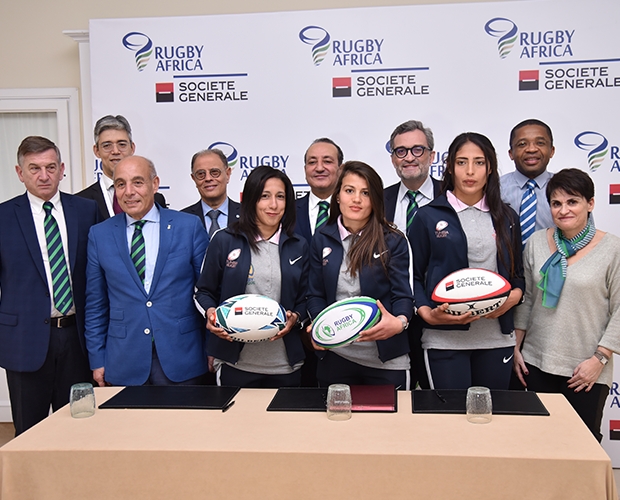
This new partnership is an additional milestone in Societe Generale’s ongoing commitment to supporting the development and openness of rugby in France and internationally, especially in Africa.
Rugby Africa is one of the six regional associations of World Rugby, the international body that oversees the organisation of the Rugby World Cup.
The partnership will focus specifically on:
World Rugby’s Get into Rugby program, which aims to encourage everyone around the world to take up rugbyThe two official competitions for women’s rugby, the Africa Women’s Sevens, and under-20s rugby with the U20 Barthès Trophy”This partnership is the continuation of two of our long-term commitments: to rugby, of which we have been a reliable partner for over 30 years, and to Africa, with our Grow with Africa initiative, a program central to our priorities that aims to promote the sustainable development of the continent. African rugby is booming, and we intend, in association with Rugby Africa, to implement important rugby development projects as a force for social cohesion,” Caroline Guillaumin, Director of Human Resources and Communication for the Group, explained.
“This partnership uniting us with Societe Generale will give strength to the development of African rugby, especially with young people and women. Currently, around half a million children and teenagers are introduced to rugby every year in Africa. And the number of registered female players has more than tripled in recent years in Africa. This partnership is a decisive step forward for Rugby Africa as it brings the necessary investment to support this rapid growth. We thank Société Générale for the confidence they have placed in Rugby Africa and its federations,” commented Abdelaziz Bougja, President of Rugby Africa.
Societe Generale and rugby, a global commitmentSociete Generale is a long-standing partner of rugby, a sport with which the Bank shares the common values of team spirit, commitment and respect. The Bank supports the development of all forms of rugby, from the amateur level to the highest professional level:▪ In France: it is partner to more than 450 amateur clubs in France, the Top 14, PROD2, the French Rugby Federation (FFR) as well as the French national rugby team.▪ Internationally, it is a major partner and the official bank of the Rugby World Cup for the sixth time, a partner of Rugby India (Indian Rugby Federation) and title sponsor of the rugby sevens national teams in all categories (men, women and junior) since 2017, backer of the association Terres en Mêlées and partner of the Algerian Rugby Federation.